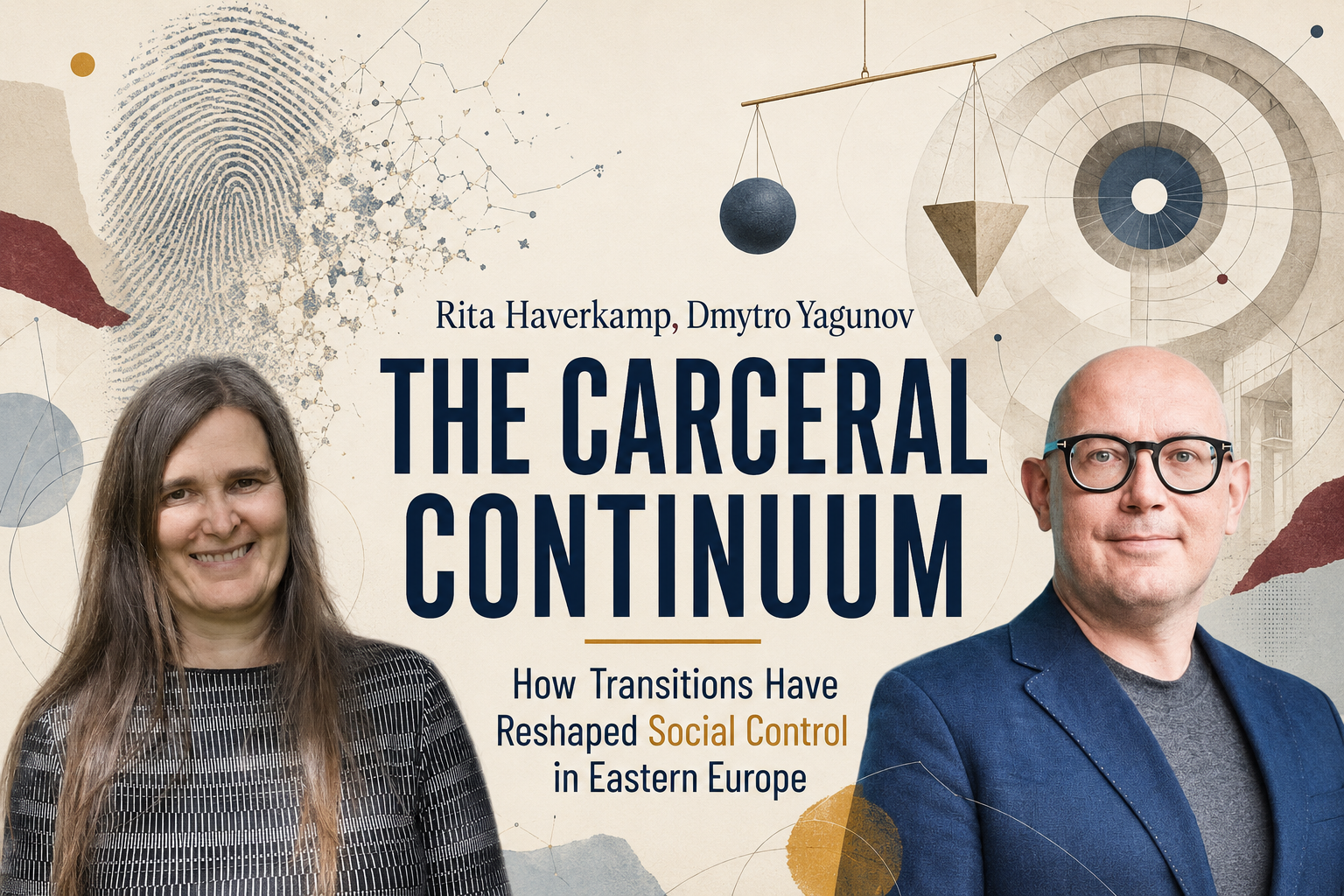
Rita Haverkamp, Dmytro Yagunov: The Carceral Continuum – How Transitions Have Reshaped Social Control in Eastern Europe
The countries of Eastern Europe constitute a unique setting for studying profound transformations of social control. In no other region of the world has the transition from one model of punishment to another proceeded with such speed, radicalism, and internal contradiction. It is precisely for this reason that the conceptual framework of the “carceral continuum” – the notion that institutions of social control do not disappear but rather transform themselves while preserving the underlying logics of discipline and isolation – proves especially productive for analysing societies of the former “socialist camp”.
The transformation of alternative sanctions in these countries differs substantially from analogous processes in Western Europe. The transition from the Soviet penitentiary model – under which the imprisonment rate exceeded a thousand persons per 100,000 population – to Central European standards took place with extraordinary speed. This warrants characterising the process not as a gradual evolution but as a radical institutional revolution. At the same time, unlike revolutions in the sphere of substantive law, this institutional transformation left a considerable part of the underlying substructures – mental, organisational, and practical – effectively unchanged.
A theoretical understanding of post-Soviet transformations is impossible without recourse to the classical heritage of critical criminology. Rusche and Kirchheimer laid the foundations for a materialist understanding of punishment, revealing its relationship to the labour market and prevailing economic conditions. Foucault, in analysing the “diffusion of panoptic discipline”, exposed the mechanisms through which power reproduces itself via institutions of isolation, surveillance, and normalisation. Despite shifts in their declared aims, these mechanisms are reproduced with remarkable persistence in post-Soviet societies.
Particularly productive for understanding post-Soviet realities is Foucault’s schema of the “binary code of legality – disciplinary mechanism – security apparatus”, which, under twenty-first-century conditions, can be extended to a fourth level – the “panoptic risk modulator”. This concept captures the systemic management of deviants through the controlled and economically expedient reproduction of deviance as a quasi-commodity with commercial characteristics. This logic – the transformation of deviance into a managed resource of the bureaucratic system – manifests with particular clarity in post-Soviet probation services, where formal rehabilitative rhetoric coexists with the de facto preservation of administrative control.
Stanley Cohen described the “punitive city” as “a recently evolving carceral environment marked by the dispersal and penetration of social control beyond the prison walls”. Under conditions of post-Soviet transition, this metaphor acquires a literal meaning: the police, prisons, numerous registers, for deviants, probation, administrative supervision in its many overt and disguised forms, and, more recently, digital means of control transform the space of everyday life into an extended place of confinement. Bauman and Albrecht rightly pointed to a shift, in contemporary late-modern society, from “the return of deviants to society” towards “the protection of society from actual or potential deviants” – and it is precisely this logic that dominates the criminal policy of most post-Soviet states.
Despite the formal introduction of progressive mechanisms – pre-sentence reports, risk-assessment instruments, and methods for individualised casework – the Ukrainian probation service remains an excessively bureaucratised structure. The declared principles of social reintegration and resocialisation diverge substantially from actual practice, which remains predominantly administrative-control-oriented rather than rehabilitative in character. This contradiction – between the rhetoric of reform and the logic of managerial control – is a structural feature of transitional societies rather than a temporary malfunction.
It is important here to take into account a broader tendency observed in Western European countries: the “treatment of offenders” is giving way to “managerialist indicators of economically justified protection of society” and to a form of socio-technological control that does not exclude the rhetoric of democratic values and human rights. Post-Soviet probation systems illustrate this logic in an especially instructive and concentrated form: the formal adoption of Council of Europe standards proceeds in parallel with the preservation of an internal culture that remains hierarchical and carceral rather than service-oriented.
At the same time, the processes of probation transformation in post-Soviet societies possess a specific postcolonial dimension. The Soviet penitentiary system – above all the Gulag as its limiting expression – shaped not merely an institutional culture but also deep-seated moral intuitions concerning the nature of deviance, correction, and social danger. These intuitions are reproduced in practices of “penological pessimism” – a conceptually grounded abandonment of genuine rehabilitative work in favour of declarative control.
Russia’s full-scale armed aggression against Ukraine since February 2022 has significantly aggravated these existing structural problems. From a theoretical standpoint, the transformation of the probation system under conditions of war confirms Foucault’s conceptual propositions, and those of his successors, regarding the economic and socio-political determination of punitive practices: the redistribution of state resources in favour of defence inevitably narrows the scope for rehabilitative work. At the same time, the militarisation of society and the intensification of punitive attitudes are observed in other Eastern European countries as well, where the problem of forced displacement and the general atmosphere of security crisis create fertile ground for populist criminal policy.
Martial law generates specific regimes of social control that only partially coincide with ordinary criminal law. Mobilisation legislation, restrictions on freedom of movement, expanded police powers, and the broadening of criminal liability in the sphere of security together form new spaces of “quasi-confinement” that extend the carceral continuum far beyond the boundaries of formal penitentiary institutions. The concept of a “criminal law of risk”, as opposed to a “criminal law of freedom”, acquires concrete wartime expression: the threat to security becomes a sufficient basis for the normative deviantisation of broad social groups.
Particular attention should be paid to the phenomenon of the dehumanisation of criminal deviants in a society at war. Where public attention and state support are concentrated on veterans, refugees, and victims of aggression, the clients of the criminal justice system find themselves on the periphery of social concern, which complicates the implementation of rehabilitation programmes. This tendency fits within the broader process described by the concept of the “quasi-deviant”: as the threshold of deviantisation is lowered, ever larger social groups come under the operation of punitive mechanisms, while the social legitimacy of those mechanisms grows.
It should be emphasised that the dehumanisation of deviants in wartime is not a purely Ukrainian peculiarity. This is a recurring pattern documented across numerous conflicts. In the Ukrainian context, however, it is superimposed on an already existing structural problem: the Soviet legacy of the punitive system did not allow a strong tradition of rehabilitative work, or a corresponding public culture, to take shape. The war therefore merely intensifies and legitimises pre-crisis practices rather than creating them from nothing.
At the level of practical trends, the Ukrainian probation system has developed two fundamentally new priority areas. The first is work with veterans who have returned from the front with post-traumatic disorders and who constitute a specific high-risk group requiring qualitatively new methodological approaches. The second is probation supervision of persons convicted of offences against national security and in the sphere of armed-forces recruitment, in particular for obstructing the activity of territorial recruitment centres.
Neither of these areas has a stable methodological tradition in Ukraine, which is in itself symptomatic. Veterans as probation clients constitute a challenge that the United States faced after Vietnam and Iraq, and the United Kingdom after the Afghan campaigns. However, given that the post-Soviet probation model remains, even now, more an administrative than a therapeutic service, integrating programmes for working with veterans’ psychological trauma requires profound organisational restructuring.
This last aspect is of considerable importance for the broader European discussion on models of armed-forces recruitment. Reliance on compulsory mobilisation rather than on the formation of a professional army inevitably generates a substantial number of new offences and, correspondingly, an increased burden on probation and penitentiary services. Mobilisation-related offences provide a vivid example of “quasi-deviants”: persons who come within the orbit of criminal law not as a result of traditionally criminalised conduct, but as a result of the expansion of the very definition of deviance in response to an external security challenge.
This tendency confirms the thesis that, under conditions of polycrisis, the state does not contract but rather expands its punitive apparatus, drawing ever new categories of persons into it. The probation and penitentiary systems are being transformed into instruments for the management of mass “danger” rather than of individual rehabilitation. According to the Dmytro Yagunov’s concept of “penological pessimism”, this process reflects a fundamental orientation of contemporary criminal policy: the genuine protection of society gives way to the institutionalisation of social control.
The tendencies described are not purely Ukrainian. They are part of a broader dynamic of the transformation of social control in Eastern Europe, in which several intersecting processes occur simultaneously: an unfinished post-socialist transition, mounting pressure from security crises – both real and symbolic – and the influence of populist criminal policy. The countries of Eastern Europe demonstrate variant responses to these challenges, united by a rhetorical appeal to the “protection of society” together with a practical narrowing of rehabilitation programmes.
At the same time, it is important to take account of the difference between Ukraine and other post-Soviet states: Ukraine is the only large post-Soviet state simultaneously experiencing active armed conflict, mass population displacement, and a process of European integration – three powerful vectors that deform the logic of the carceral system in different ways. This unique configuration makes Ukraine a particularly valuable object of comparative penological research.
The concept of the carceral continuum makes it possible to view the transformations of social control in Eastern Europe not as a series of discrete reforms but as a continuous process of the reconfiguration of the institutions of discipline and supervision. The Soviet legacy, the post-socialist transition, wartime mobilisation, and digitalisation are not sequential phases but simultaneously operative layers that interact with, and reinforce, one another in shaping present-day practices of punishment and control.
The conceptual tools of Foucault and Cohen remain productive for the analysis of this process, yet they require adaptation to the conditions of the twenty-first century – in particular, to the phenomena of the “panoptic risk modulator”, “penological pessimism”, and the “quasi-deviant”. It is precisely this analytical framework that opens up the prospect of a systematic comparative study of the transformations of social control in Eastern Europe under conditions of polycrisis – a study that is urgent from both a scholarly and a practical point of view.
Penological pessimism is a state of crisis of trust in criminal and penitentiary policies and practices, under which punishment loses its rational, purposive justification (resocialisation, deterrence, restoration of justice) and turns into a self-sufficient instrument of social control and social exclusion of “quasi-deviants” (Dmytro Yagunov).

Quasi-deviants are a category of individuals or social groups who, within the postmodern discourse of social control, are artificially and largely declaratively (i.e., without formal establishment of the commission of a crime or an act of deviant behavior) included by ruling political actors in a continually expanding list of “deviants” solely on the basis of real or even purely potential danger or risk they allegedly pose; as a result, the boundary between them and “honest citizens” gradually blurs, while they themselves – despite their actual vulnerability, defenselessness, and remoteness from power – become the target of an increasingly deep and pervasive social-control and surveillance impact aimed not at retribution for what was committed, but at securing society and expanding power control as such (Dmytro Yagunov).

Deviant state is a state that, despite formal recognition of the absolute prohibition of torture and other ill-treatment and despite international obligations against torture, is systematically unable to adhere to even minimal requirements for preventing ill-treatment in places of detention due to a policy of over-incarceration driven by the pursuit of “security,” which leads to overcrowding of facilities, resource deficits, the spread of prison subculture and violence – thereby falling into a vicious circle in which the state policy of criminalisation and imprisonment of citizens generates systematic violations by the state of its own anti-torture standards (i.e., “auto-deviantisation” of the state), turning it simultaneously into the subject responsible for ill-treatment and the victim of its own criminal and penitentiary policy (Dmytro Yagunov).