Prison Subculture as National Culture: When Prison Slang Becomes the National Language
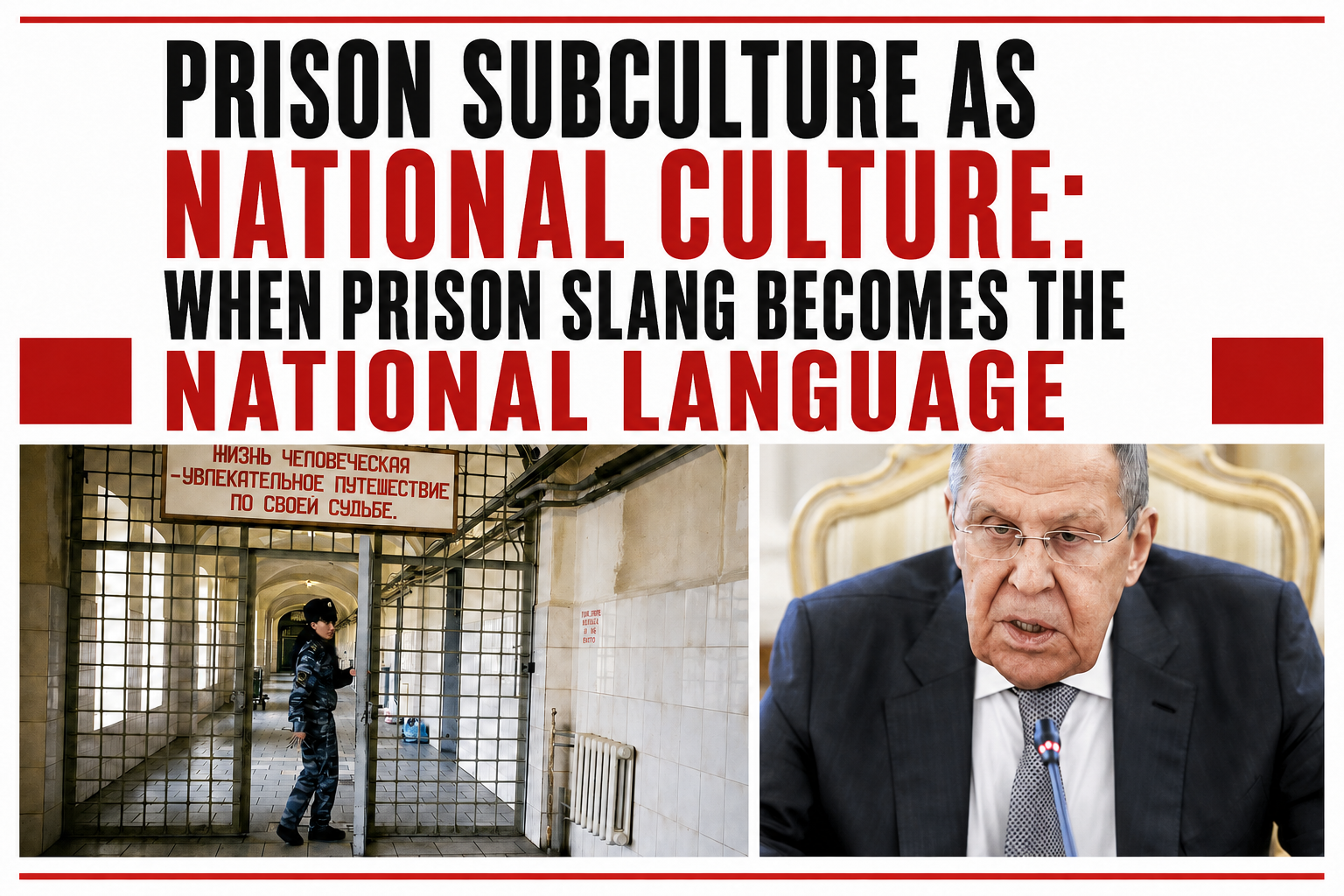
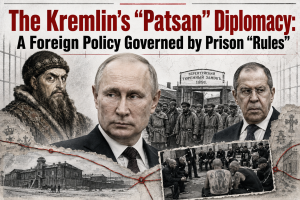
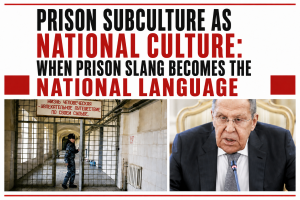
The occasion for this text was a remark by Russian Foreign Minister Sergei Lavrov, made on 24 July 2026 at a press conference in Cholpon-Ata, Kyrgyzstan. Lavrov was responding to a statement by US Secretary of State Marco Rubio, who the day before, summing up the talks in Manila, had declared the failure of the agreements reached in Anchorage. Instead of diplomatic polemics about the substance of the agreements, the minister reached for a formula straight out of the prison camp: “a guy’s word is a guy’s word – a guy said it, a guy did it” («слово пацана – пацан сказав, пацан зробив»). This phrase – as accidental as it is, at the same time, revealing – is precisely the starting point for a conversation about which culture actually shapes the language, logic, and hierarchy of power within the system that the author of this quote represents.
There is a peculiar dialectical beauty in the fact that the foreign minister of a great power, commenting on the collapse of international agreements, resorts not to diplomatic vocabulary but to a formula familiar to anyone who has ever heard of “the zone” [prison camp]. This phrase is neither a slip of the tongue nor stylistic carelessness, but an entirely consistent admission: the real grammar of power in this coordinate system is not international law, not the text of an agreement signed by delegations, but a code forged not in the chambers of the Vienna Convention, but in barracks and transit prisons.
It is customary to assume that a state operates through law, diplomacy, and institutions. But when the top official of a foreign ministry appeals to street-code honesty as the supreme arbiter of international obligations, it becomes obvious: legal language here is merely a decorative facade, while the real regulator remains the unwritten code of “the concepts” (Ponyatiya) – the very same code that determines hierarchy within a confined space, where freedom is viewed through bars, and one’s own rightness is confirmed not by argument but by status.
This substitution is neither accidental nor new. It is the logical outcome of a long evolution in which the camp experience ceased to be a marginal page of history and became a source of governing culture. A state, a significant part of whose recent history passed through camps, pretrial detention facilities, and forced labor, ultimately absorbed the lesson: a hierarchy of authority built on fear and the status of “the elder” is more effective than institutional accountability. Thus Ponyatiya – an unwritten but rigidly binding code of rules for coexistence within the zone – moved beyond the perimeter of barbed wire and became, in essence, the state’s operating system.
Hence the telling rhetorical construction one can observe in public statements: an agreement is not fulfilled – meaning the partner acted “against the code” [«не по понятіях»]; a side that refuses to accept a compromise is a “traitor,” a “non-human” – categories borrowed not from diplomatic vocabulary but from the hierarchy of internal camp statuses. A political opponent is not merely mistaken – he violates a code of honor written not by jurists but by criminal authorities.
In academic terms, we have a unique case: a state functioning as a penitentiary institution that has outgrown its institutional form while preserving its operating logic. The vertical of power replicates the vertical of the barracks: proximity to “the boss” [«хазяїна»] matters more than competence, loyalty matters more than law, and any attempt to publicly articulate dissent is equated with a breach of internal discipline. The citizen in such a system is not a subject of law but an “inmate” [«сиділець»], whose rights derive from the guard’s goodwill rather than from constitutional guarantees.
The irony – and here it is a rather bitter one – lies in the fact that a system which for decades exported the rhetoric of “spirituality” and a “civilizational mission” is in reality exporting precisely a camp anthropology: a cult of force in place of a cult of law, a cult of status in place of a cult of dignity, a cult of silent submission in place of a cult of civic responsibility. And when a foreign minister, live on air, appeals to a street-code word of honor as the highest form of international legitimacy, he – without meaning to – reveals the system’s true constitution: unwritten, never officially spoken, yet entirely real.
What remains is a question that academic irony gladly leaves rhetorical: can one negotiate at all with a state whose highest legal norm is not international law but a word given “according to the code”? History, it would seem, has already given its answer – it is simply that not all participants in the negotiating process are in a hurry to hear it.