The Torture Quasi-Compromise During Mobilisation: From “Busification” to Systemic Violations of Article 3 ECHR
The absolute prohibition of torture is an unconditional and immeasurably important idea of modern constitutionalism and international human rights law. It is not merely a norm enshrined in Article 3 of the Convention for the Protection of Human Rights and Fundamental Freedoms, but also the philosophical foundation of the functioning of the modern state: a guiding principle for the activities of public authorities, a philosophy of the work of state institutions, and the basis for citizens’ claims against the state concerning the principal, fundamental principles of interaction between the state and the individual. This ideal is not open to discussion and is not subject to doubt. It is indisputable.
However, every absolute encounters the reality of its implementation, and it is precisely in the sphere of implementation that its principal weakness is revealed. The Ukrainian state during the war has demonstrated this weakness with the utmost clarity. Notwithstanding Article 15 of the Convention, which expressly excludes derogation from Article 3 of the Convention even in time of war or other public emergency threatening the life of the nation, the state in fact derogates from the absolute prohibition of torture precisely when the very existence of the state within its borders is at stake. This occurs not through a formal derogation, but through a silent, yet entirely deliberate, toleration of practices which by their nature fall within the scope of Article 3.
We must acknowledge this, and we must speak about it. Silence regarding this phenomenon is a precondition for its further covert legitimisation in conditions of crisis, and not only in Ukraine, but also in other European countries whose legal systems have been built over the past half-century on the principles of the legal space of the Council of Europe. It is for this reason that the subject of this article is neither a denial of the absolute prohibition of torture nor a search for justifications for the state, but an honest identification of a phenomenon which we propose to call, provisionally, the “torture quasi-compromise”.
STATEMENT OF THE PROBLEM
The Ukrainian scenario has demonstrated that during a war, which is a reality that cannot be denied, the question is placed on the agenda of the extent to which the state can survive without compulsory mobilisation. The problem is that compulsory mobilisation in Ukrainian conditions has proved to be inextricably linked to the use of ill-treatment and, in a significant proportion of cases, torture. This may sound harsh and may provoke, and certainly will provoke, criticism. But we are speaking of realities, not of a normative ideal.
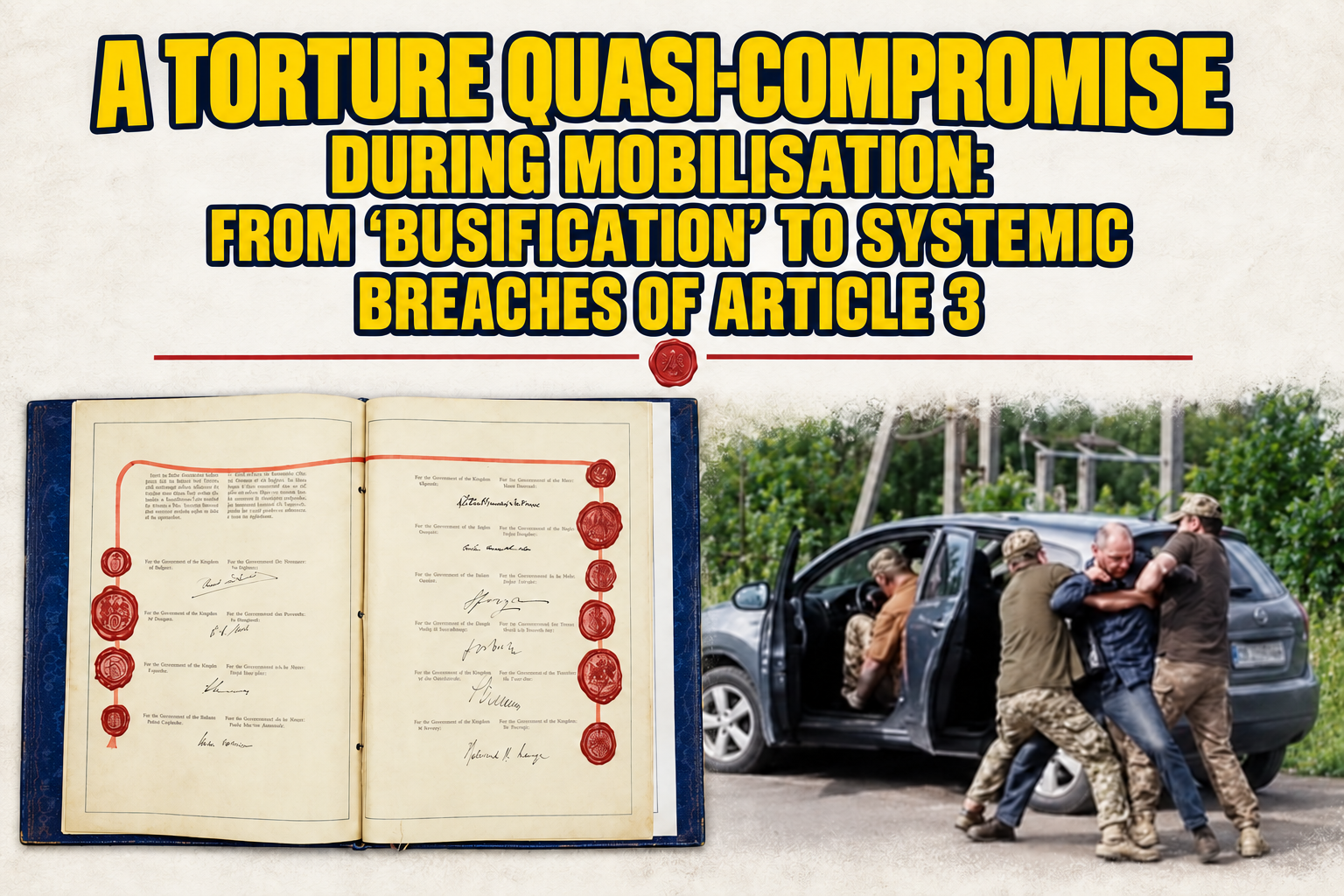
When the state deliberately derogates from the absolute prohibition of torture, and this derogation is in fact not concealed at the national level, the manifestation of such derogation becomes a phenomenon which in Ukrainian society has acquired the name “busification” (busyfikatsiia). This word, which did not exist in the Ukrainian language just a few years ago, is today instantly recognised by every inhabitant of the country and denotes an entirely specific set of practices: the sudden apprehension of a man on the street, in a public place, at his workplace, in his own home or in his yard by officers of a Territorial Centre of Recruitment and Social Support (TCR), his forcible placement into a vehicle, and his transportation to the TCR or directly to a training centre or military unit.
It is here that we identify the torture quasi-compromise. Its essence lies in the fact that the state turns a blind eye to mass unlawful apprehensions, which by their nature constitute manifestly unlawful deprivation of liberty and which, as a rule, are accompanied by ill-treatment. This ill-treatment takes place both at the moment of apprehension and subsequently. It occurs in public places and on the streets, as well as directly in the apartments and yards of citizens, when TCR officers, who, as the state itself asserts, have no authority to stop, detain or deprive persons of their liberty, nonetheless do so in an undisguised manner. Accordingly, not only Article 3 and Article 5 of the Convention come under attack, but also Article 8, since the right to respect for private and family life and the inviolability of the home are in these situations not regarded as existing at all.
As a result, an atmosphere of total tolerance of ill-treatment is created. Moreover, this tolerance extends both to the moment of apprehension and to the subsequent stages. The phenomenon of busification consists in the fact that even where the apprehension itself takes place without obvious signs of physical violence, it is, as a rule, only the first link in a chain. Next come persons who cannot be mobilised on health grounds, but who are nevertheless sent to the front. It is precisely here that the nexus lies between mass unlawful apprehensions (de facto arrests, since they may be called whatever one likes, but their essence does not change), the forgery of mobilisation documents, and the dispatch to the front of persons who are not subject to conscription on medical grounds.
In at least half of the cases, and possibly more, this path is accompanied by ill-treatment or torture, specifically during apprehension, during transportation to the recruitment centre, or directly on the premises of the TCR. What is at issue is not isolated excesses on the part of individual perpetrators, but a mass, recurrent, systemic practice which at the state level receives no adequate criminal-law or disciplinary response.
THE FIRST THESIS: THE REALITIES OF WAR AGAINST THE ABSOLUTE OF ARTICLE 3 OF THE CONVENTION
The first point on which we insist is the following: however much we may exalt the absolute prohibition of torture, however often we may repeat that even in time of war torture and other forms of ill-treatment are outside the law, realities do their work. A state waging a war for survival finds a way to circumvent the absolute without formally denying it.
An important historical clarification is required here. Such practices are not new. Every war, as history testifies, has been accompanied by compulsory mass mobilisation, unlawful deprivation of liberty, de facto falsification of mobilisation documents, and so on. However, between what occurred during the First and Second World Wars and what contemporary Ukraine demonstrates there lies a chasm. This chasm was created by the establishment of the Council of Europe, the European Court of Human Rights, the European Committee for the Prevention of Torture and Inhuman or Degrading Treatment or Punishment, and the corresponding body of Council of Europe law upon which member states build their national legal systems. This applies all the more to the European Union, within the framework of which a unique legal system of its own for the protection of fundamental rights has been created.
It is precisely the emergence of the phenomenon of busification that distinguishes today’s situation from what took place during past European and world wars. The problem is not that mass compulsory mobilisation as such is a historical novelty, but that such a phenomenon exists and reproduces itself within the legal system of the Council of Europe, of which Ukraine has been a member since 1995, and after three decades of development of the case law of the European Court of Human Rights, in which the absolute character of Article 3 has been repeatedly confirmed, including in Ireland v. the United Kingdom, Selmouni v. France [GC] and Gäfgen v. Germany [GC].
In other words, the Ukrainian case is the first instance in which a member state of the Council of Europe, while under the full jurisdiction of the European Court and under the monitoring of the European Committee for the Prevention of Torture, wages a full-scale war for its existence and at the same time demonstrates that the absolute of Article 3 of the Convention proves, in practical terms, to be absolutely vulnerable. This is not an argument against the absolute. It is an argument in favour of the proposition that the absolute requires institutional safeguards, and not merely declarations.
THE SECOND THESIS: WHY THE WEST SEES ARTICLE 5 BUT DOES NOT SEE ARTICLE 3
The second thesis concerns the perception of Ukrainian realities outside Ukraine. The scale and nature of compulsory mobilisation in Ukraine, the reverse side of which frequently becomes ill-treatment, are undoubtedly noticed and analysed in other Council of Europe states and in the European Union. However, for the most part these practices are viewed through the prism of unlawful deprivation of liberty, unlawful apprehensions and other violations of the right to liberty – that is, predominantly in the categories of Article 5 of the Convention.
As a consequence, what in Ukraine has acquired the features of a mass practice of ill-treatment during or after unlawful apprehension is perceived in the West merely as a mass practice of unlawful deprivation of liberty. The violent, degrading and potentially torturous component of this phenomenon remains on the periphery of analysis. Thus, a problem which requires an independent qualification under Article 3 of the Convention is in fact reduced to a question of compliance with Article 5 of the Convention.
What the population of a country at war perceives as something understandable and commonplace, where words such as “TCR” or “busification” evoke a typical and characteristic reaction that is understood without explanation, is perceived in the West, even taking into account the mass scale of the phenomenon, merely as unlawful deprivation of liberty. That is, at most as a problem under Article 5 of the Convention, but by no means as a problem under Article 3 of the Convention, still less in its mass dimension.
THIS SHIFT OF OPTICS HAS AT LEAST THREE CAUSES.
First, the statistical and documentary base concerning ill-treatment during mobilisation is fragmentary: the victims are in military units, have no access to a lawyer, do not have their bodily injuries recorded, and criminal proceedings under the article on “torture” are either not opened or have no prospect. Second, the Western observer is inclined to apply to Ukraine a presumption of good faith on the part of a state defending itself against aggression, and therefore to interpret excesses as individual violations rather than as a systemic practice. Third, the very category of “deprivation of liberty” is cognitively more convenient: it does not require a threshold of severity of suffering, and it does not pose the uncomfortable question of whether a state that is the victim of aggression is at the same time a state that permits torture.
The consequence of this shift is that the phenomenon of busification remains outside proper legal qualification. Yet the case law of the European Court is unequivocal: any recourse to physical force against a person under the control of state agents which was not made strictly necessary by that person’s own conduct diminishes human dignity and is in principle a violation of Article 3 (Bouyid v. Belgium [GC]). There is no basis whatsoever for considering that this standard does not apply to TCR officers who physically restrain a person, place him in a vehicle, strike him or use special means, or hold him on premises without access to water, food, medical assistance and contact with relatives. Nor is there any basis for considering that the dispatch to the front, on the basis of forged documents, of a person who is unfit for service on health grounds does not raise a separate issue under Article 3 of the Convention, and, in the event of death or serious injury, also under Article 2 of the Convention.
Thus, the second principal aspect on which we insist is that the legal qualification of busification must be transferred from the sphere of Article 5 of the Convention to the sphere of Article 3 of the Convention taken in conjunction with Article 5 of the Convention, and that the mass scale and recurrence of this practice must be regarded as indicators of a systemic problem rather than as an aggregate of isolated incidents.
THE THIRD THESIS: A PROFESSIONAL ARMY AS A SAFEGUARD AGAINST TORTURE AND CORRUPTION
The third thesis is, in our view, the most important from the standpoint of political conclusions. The Ukrainian case has demonstrated how closely interlinked are the issues of creating a professional army, preventing corruption and preventing torture. These three problems are usually considered separately: reform of the armed forces is discussed in the categories of defence policy, corruption in the categories of economics and governance, torture in the categories of human rights. The Ukrainian experience shows that this is one problem with three faces.
In a system of coordinates in which the political elites display a manifest unwillingness to halt corruption schemes and to cut off corruption flows, while at the same time turning a blind eye to the phenomenon of busification, this cannot but lead to the accumulation of acute tension in society between the political elites and the rest of the population. Mobilisation that is carried out through coercion, violence and the forgery of documents, and which at the same time allows some to buy their way out while forcing others to fight contrary to their state of health, destroys the very idea of solidarity on which the defence of the state must rest. Torture during mobilisation and corruption surrounding mobilisation are not two separate phenomena, but two sides of one mechanism: where there is the possibility of unlawfully detaining, there arises the possibility of unlawfully releasing in exchange for a reward.
It is precisely for this reason that the creation of a professional army with properly remunerated military personnel and corresponding obligations voluntarily assumed by soldiers and officers was, from the very outset, the safeguard against torture which Ukraine could and should have adopted in the past. A professional army, a properly trained reserve and a transparent system of incentives substantially reduce the state’s dependence on chaotic compulsory mobilisation, although during a full-scale war they are not always capable of entirely eliminating the need for conscription. Such a set of measures substantially narrows the space for mass unlawful deprivation of liberty and, together with it, for the ill-treatment that accompanies compulsory mobilisation.
This is the principal message that must be proposed and disseminated among Western governments. As the Ukrainian case shows, in the event of war, even within a country that forms part of the legal system of the Council of Europe, in the absence of proper military training of the population and of appropriate incentives – including material and financial ones – for people to take up arms in defence of their country, the reverse side of the absence of such a policy for organising the armed forces will inevitably be mass compulsory mobilisation with the corresponding mass apprehensions and mass instances of ill-treatment. This pattern is not unique to Ukraine. It is structural, and any European state which today is discussing the reintroduction of conscription or preparing for a potential conflict must look at the Ukrainian experience not as an exotic curiosity, but as a warning.
CONCLUSIONS
In summary, we propose three interrelated theses which form the basis of this article.
First, the absolute prohibition of torture, notwithstanding Article 15 of the Convention, has in practical terms proved to be absolutely vulnerable for a state waging a war for survival. Ukraine, being a member of the Council of Europe and under the jurisdiction of the European Court of Human Rights, has in fact derogated from the absolute of Article 3 through the toleration of the phenomenon of busification. This must be acknowledged and must be spoken about, since silence is the first step towards the covert legitimisation of torture in conditions of crisis in other European states.
Second, the Western perception of busification as a problem exclusively under Article 5 of the Convention is inadequate. Mass unlawful apprehensions accompanied by physical violence, detention in improper conditions, the forgery of mobilisation documents and the dispatch to the front of persons unfit on health grounds must be qualified under Article 3, and their systemic character must be regarded as a structural problem rather than as an aggregate of individual excesses.
Third, the Ukrainian case demonstrates the inextricable link between a professional army, the prevention of corruption and the prevention of torture. The creation of professional armed forces on the basis of incentives rather than coercion is not only a question of defence capability, but also the principal institutional safeguard against the torture compromise. It is precisely this conclusion that must become the central message for the governments of European states which today are rethinking their own models of manning their armed forces in the light of the new security realities.
The torture quasi-compromise is not inevitable. It is the consequence of specific political decisions and, more importantly, of specific political inaction. Recognition of this fact is a necessary condition for the absolute prohibition of torture to remain an absolute not only in the text of the Convention, but also in the practice of the states that have sworn allegiance to that Convention.