On 18 September 2026, the Office of the United Nations High Commissioner for Human Rights (OHCHR) published a thematic report prepared on the basis of the work of the United Nations Human Rights Monitoring Mission in Ukraine and covering the period from 24 February 2022 to 31 July 2026 (OHCHR, 2026, para. 1). The report is based primarily on confidential interviews with victims and survivors, as well as on court documents, official data and open sources; facts were included on the basis of the “reasonable grounds to believe” standard (OHCHR, 2026, paras. 9, 11). High Commissioner Volker Türk characterised the findings as part of a “shocking pattern of torture, intimidation and coercion” (UN News, 2026; Deutsche Welle, 2026).
In total, 1,004 cases were documented, of which 984 relate to the reporting period, while 20 occurred before 2022 but had not previously been recorded; one “case” denotes one victim and may encompass multiple episodes of violence (OHCHR, 2026, para. 2). Eighty-nine per cent of the cases were attributed to the authorities of the Russian Federation (the armed forces, the Federal Penitentiary Service (FSIN), the Federal Security Service (FSB)), and 11 per cent to the authorities of Ukraine (the Armed Forces, the State Criminal Executive Service, the Security Service of Ukraine (SBU)) (OHCHR, 2026, para. 3).
According to a calculation based on the report’s data, more than 80 per cent of the victims (823 of 1,004) are men, predominantly in places of deprivation of liberty; women and children were affected mainly in occupied territory (OHCHR, 2026, paras. 16, 60; UN News, 2026). OHCHR stresses that these data are representative but not exhaustive: the Russian Federation granted access neither to the occupied territories nor to prisoners of war and civilian detainees, while many victims and survivors do not come forward because of trauma, shame, stigma, fear of being accused of collaboration and distrust of law enforcement bodies, so that the actual number is considerably higher (OHCHR, 2026, paras. 10, 13; Radio Svoboda, 2026). The key finding is that sexual violence was used as a method of torture and other forms of cruel, inhuman or degrading treatment or punishment (OHCHR, 2026, para. 2).
A total of 892 cases were attributed to the Russian authorities (725 men, 151 women, 14 girls and 2 boys) in three contexts (OHCHR, 2026, para. 16). The first concerns Ukrainian prisoners of war and retained medical personnel: of the 915 persons interviewed after their release, 572 (63 per cent) gave consistent and detailed accounts. A total of 155 persons (27 per cent) were subjected to electric shocks to the genitals administered with a TA-57 field telephone (known as a “tapik”) or a stun gun, 246 (43 per cent) to beatings to the genitals, and 372 (65 per cent) to forced nudity; 75 per cent were subjected to several forms of violence, 72 per cent repeatedly, and 48 per cent in several places of detention, which points to the systemic nature of the practice (OHCHR, 2026, paras. 17–23).
Violence accompanied every stage of captivity – from capture and transfer, the “admission” procedure and interrogations to cell searches and the final days before exchange; it was most often perpetrated by FSIN personnel, and it was recorded in 83 official facilities and 81 unofficial or transit locations in six regions of Ukraine and twenty-five regions of the Russian Federation (OHCHR, 2026, paras. 21, 24–30).
The second context concerns civilian detainees: 205 cases (156 men, 48 women, 1 boy), including 13 rapes, predominantly during interrogations aimed at obtaining information or confessions or at coercing cooperation; a further 19 cases from 2014–2022 attest to the continuity of this practice (OHCHR, 2026, paras. 31–33, 38).
The third context is violence outside places of deprivation of liberty, in towns and villages under occupation: 95 civilians (72 women, 8 men, 14 girls, 1 boy), 57 rapes, of which 15 were gang rapes; the youngest victim was four years old and the oldest 82, and three women gave birth to children as a result of rape (OHCHR, 2026, paras. 42–43; Sheludkova, 2026). Typical circumstances included the unauthorised quartering of soldiers in private homes, searches, abductions and “filtration”; most of the cases date from March–November 2022, but cases were also recorded in 2025, so that the risk to women and girls in frontline communities persists (OHCHR, 2026, paras. 50–56).
The responses of the two States differ fundamentally. OHCHR is not aware of any steps taken by the Russian Federation to investigate or prosecute such acts; on the contrary, Federal Laws No. 270-FZ (2023) and No. 64-FZ (2024) exempt servicemen from criminal liability, procedural safeguards in places of detention do not operate, and doctors were in some instances present during the abuse or took part in it (OHCHR, 2026, paras. 5, 57–58). The broader context also includes the fact that in September 2025 Russia denounced the European Convention for the Prevention of Torture and Inhuman or Degrading Treatment or Punishment, and that in May 2026 it was for the first time included in the “blacklist” of the UN Secretary-General on conflict-related sexual violence (Sheludkova, 2026).
At the same time, Ukraine grants OHCHR full and confidential access, and in official places of detention the safeguards are generally respected; a Framework of Cooperation with the United Nations has been concluded (2022), a specialised unit operates within the Office of the Prosecutor General, the Rome Statute has been ratified, and Law No. 4067-IX on urgent interim reparations has been adopted, together with its implementing regulations (June 2026) (OHCHR, 2026, paras. 7, 77–81).
The recommendations are addressed to all parties (to cease all forms of sexual violence, to introduce prevention plans, to investigate all cases promptly, thoroughly and impartially, holding commanders accountable as well, and to ensure reparations and comprehensive services for victims and survivors), to the Russian Federation (to cease the use of force and withdraw its troops, to condemn the violence publicly, to grant access to independent monitors, and to repeal the provisions on exemption from liability), to Ukraine (to protect prisoners of war during the initial stage of captivity and transfer them to official places of detention as quickly as possible, to involve survivors in the design of services, and to allocate the necessary resources for the implementation of the law on reparations) and to the international community (OHCHR, 2026, paras. 85–88).
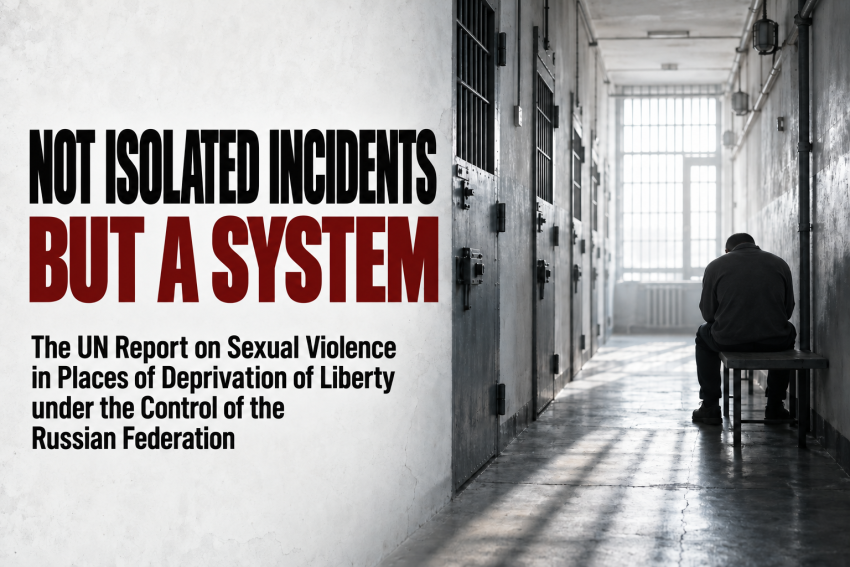
In the words of the High Commissioner, those responsible must be held to account “regardless of rank or affiliation” (UN News, 2026). The report thus records not isolated incidents but sexual violence as a component of a system of torture in places of deprivation of liberty under the control of the Russian Federation; the asymmetry between the parties lies not only in scale but also in the institutional response: legislatively entrenched impunity on the one side, and cooperation with monitoring mechanisms on the other, albeit with the process of holding perpetrators to account still incomplete.
References
Deutsche Welle. (2026, September 18). Voina v Ukraine: OON zafiksirovala bolee 1000 sluchaev seksualizirovannogo nasiliia [War in Ukraine: UN recorded more than 1,000 cases of sexualized violence]. https://amp.dw.com/ru/vojna-v-ukraine-oon-zafiksirovala-bolee-1000-slucaev-seksualizirovannogo-nasilia/a-79332238
Office of the United Nations High Commissioner for Human Rights. (2026). Sexual violence in the context of the Russian Federation full-scale armed attack against Ukraine: 24 February 2022 – 31 July 2026 (A/HRC/63/CRP.2). https://www.ohchr.org/sites/default/files/documents/hrbodies/hrcouncil/sessions-regular/session63/a-hrc-63-crp-2.pdf
Radio Svoboda. (2026, September 19). OON opisala 1004 sluchaia seksual’nogo nasiliia v khode voiny v Ukraine [UN described 1,004 cases of sexual violence during the war in Ukraine]. RFE/RL. https://www.svoboda.org/a/oon-opisala-1004-sluchaya-seksualjnyh-pytok-v-hode-voyny-v-ukraine/33859475.html
Sheludkova, I. (2026, September 18). Seksual’noe nasilie kak oruzhie i pytka: 89% prestuplenii soversheny silami RF s nachala voiny protiv Ukrainy [Sexual violence as a weapon and torture: 89% of crimes committed by Russian forces since the start of the war against Ukraine]. Euronews. https://ru.euronews.com/2026/09/18/sexual-violence-war-russia-ukraine-un-report
UN News. (2026, September 18). Ukraina: doklad OON raskryvaet «uzhasaiushchuiu kartinu» seksual’nogo nasiliia v usloviiakh voiny [Ukraine: UN report reveals “horrifying picture” of sexual violence in wartime]. United Nations. https://news.un.org/ru/story/2026/09/1468708