The Kremlin’s “Patsan” Diplomacy: A Foreign Policy Governed by Prison “Rules”
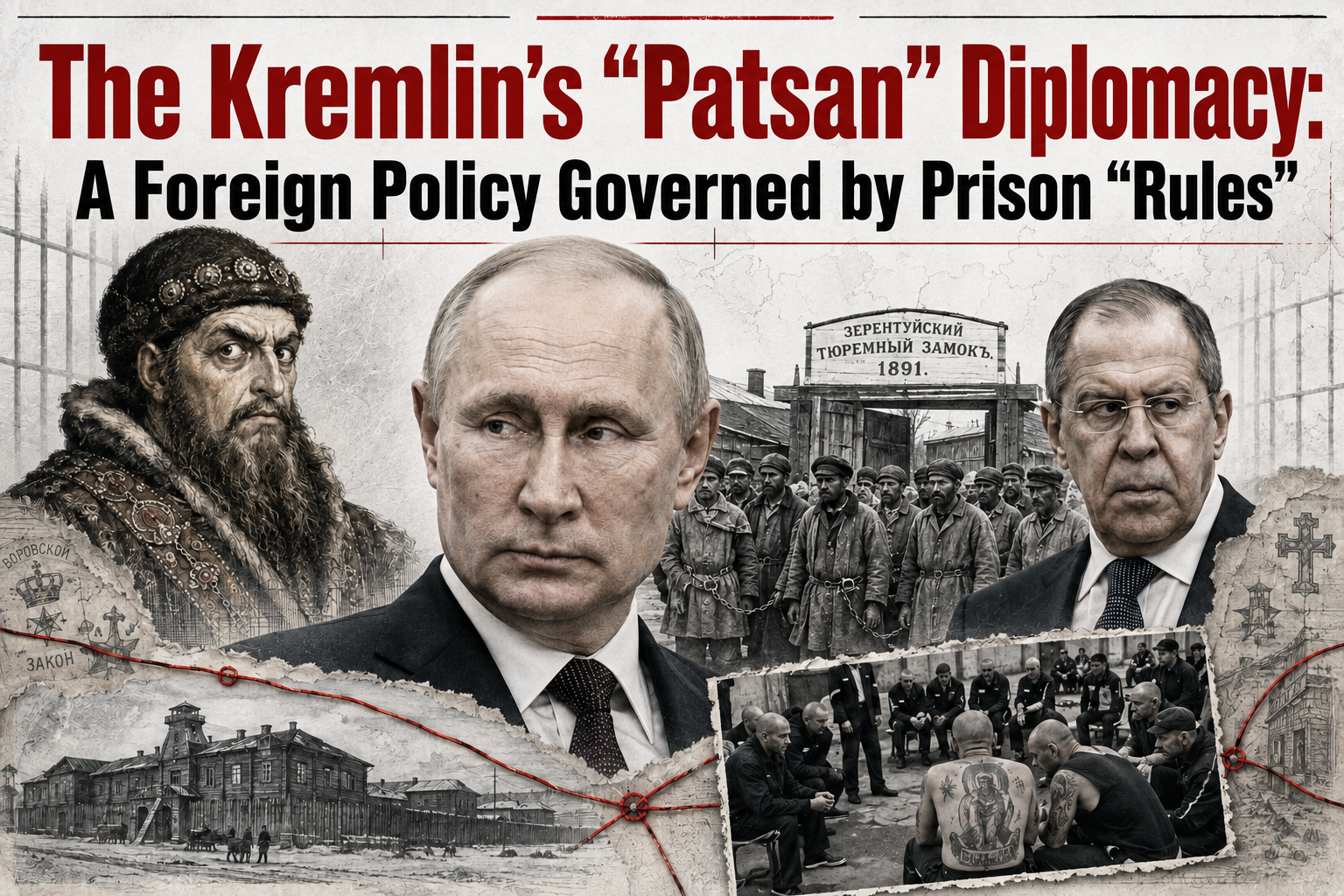
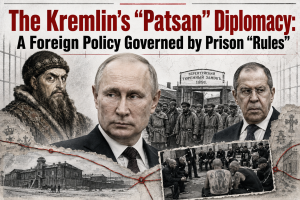
On 28 August 2026, Russian Foreign Minister Sergey Lavrov declared once again, in yet another interview, that all questions concerning Ukraine must be settled between Washington and Moscow “patsan-style” [po-patsanski] – according to the masculine street-and-prison code of the post-Soviet criminal underworld. As he put it, “one can put it nobly, or one can put it patsan-style – essentially it’s the same thing.” It was in that very spirit, he said, that Vladimir Putin flew to meet Donald Trump in Anchorage a year ago – and, according to Lavrov, the two sides literally sealed the agreement with a handshake. And when, in Lavrov’s telling, the Europeans – and Zelensky personally – later buried that agreement, Lavrov publicly reproached the Americans for conduct unbecoming of a patsan [“un-patsan-like,” nepatsanskuyu].
Funny? Not quite. It is one more, and ever less concealed, piece of evidence of the Russian Federation’s deepening descent into a state that is not even merely carceral, but a genuine prison state.
Western diplomats and analysts have spent years trying to read the Kremlin in the language of rational state interest: human rights, protection of citizens, international law, balance of power, treaties, security guarantees. And every time they are astonished when Moscow violates what it has just signed, or proposes to “agree verbally,” or answers with a strike where a compromise was expected. The reason is that they are using the wrong dictionary. Lavrov does not hide the key to reading Moscow – he names it himself: “patsan-style.” In this coordinate system a treaty is not a legal document but a ponyatie – an unwritten rule of the criminal and prison underworld – something that can be “talked through” [pereteret’] and just as easily “reneged on” [s’ehat s bazara] when circumstances or the balance of power in the yard change. Whoever keeps searching here for rationality of the Western kind is simply looking in the wrong place.
A PRISON STATE IS NOT ABOUT NUMBERS
A prison state is not about the number of prisons, nor about the number of prisoners, whether in absolute or relative figures. A prison state is when the population, society, and the state itself begin to think the way prison staff and prison inmates think, and to organize both their own lives and the work of state institutions along that model.
And the chief law inside a prison is not the formal law governing the prison system but informal, subcultural laws: an informal hierarchy, a division into “classes” – from the “blatnye” [criminal elite] to the “opushchenye” [the “lowered,” the outcast caste], the “kozly” [“goats,” those who cooperate with the administration] and the “petukhi” [“roosters,” the lowest caste] – and disproportionately cruel sanctions for any deviation from these unwritten norms.
The paradox of contemporary Russia is that this is now openly declared at the level of the state’s top-tier officials. Yes, we have built a state on the principles of an informal prison hierarchy, they say – and we are not hiding it. We hold it up, we put it on display for the world, and we guard it, because that – according to the laws of the informal prison hierarchies that have taken shape in Russia over the past five centuries – is precisely how a prison state is meant to be governed.
FIVE CENTURIES OF ONE AND THE SAME HABIT
There is nothing new here. The development of the Russian state over the past five centuries – from the first colonization of the eastern territories by means of criminal punishment and penal exile, starting with the Grand Duchy of Moscow – is simply manifesting itself right now, in the twenty-first century, after several centuries of purely formal distancing from the principles of the prison state. The form changed. The substance did not.
In the sixteenth century, penal servitude labour and criminal punishment became an instrument of the colonization of the East. In the seventeenth century, criminals, fugitives, and peasants rejected by their communities were driven en masse to Siberia, to the lands near Lake Baikal: exile increasingly became a tool of the harshest inhuman social control rather than a means of settling the territory. Criminal exiles took root poorly in their new locations and hardly engaged in farming, while the criminalized environment reliably corroded the morals of the surrounding regions, even as the economic effect of exile was almost nil.
By the 1860s, the criminal underworld of the Russian Empire – from the Siberian to the Sakhalin penal settlements – had finally taken shape as a coherent structure: its own self-government, a primitive “legislation,” a clear division of prisoners into “classes,” embryonic governing bodies, and a shared fund – the obshchak. This was the prototype of Soviet- and post-Soviet-style organized crime.
And this is not merely a cultural detail – it is a model of political economy. The obshchak, as a common fund into which “the right patsany” [“correct guys”] pay a share of their spoils in exchange for protection and status, while the leadership disposes of it at its own discretion, with no accountability to the rest – this is the very logic by which the Putin power vertical has functioned for decades: from regional governors who “share” with the center, to oligarchs who are permitted to enrich themselves for exactly as long as they “kick up correctly” and do not step outside the status allotted to them. The obshchak-state is not a metaphor for rhetorical flourish; it is a fully functioning model for the distribution of power and resources in contemporary Russia.
The elite of this world were the “brodyagi” [tramps/vagrants] and “ivany” – the future prototypes of the “vory v zakone” [“thieves-in-law”], whose power within prisons and other places of detention later became virtually unlimited. And, tellingly, the prison administration did not merely tolerate this model – it cultivated it, because staff were in short supply, corruption flourished, and the guards themselves were drawn into the prisoners’ criminal activity, including currency counterfeiting. The power delegated to the “ivany” and “brodyagi” was eagerly inherited by the USSR and developed further, and from it, in turn, by the post-Soviet states, where the delegation of power to informal leaders remains, to this day, a direct cause of inter-prisoner violence and torture – the very phenomena the European Committee for the Prevention of Torture works to combat. And it is worth emphasizing: the roots of this phenomenon are not Soviet but specifically Russian and imperial.
LANGUAGE, CARDS, SONG
This subculture has its own symbolism, and it too passed down as an inheritance from imperial Russia to Putin’s Russia. The “thieves’ language,” or fenya, and “blatnaya muzyka” [criminal argot/“thieves’ music”] are not merely slang; they are a marker of verbal, moral, and ideological belonging to the “world of penal servitude,” and the principal instrument of advancement within the informal hierarchy, available above all to the elite stratum of the criminal world. Card games are the second pillar of this order: people played purely for the sake of losing, and lost everything – money, rations, clothing, and at times even a wife or children. The third pillar is prison and convict songs, which over time were organically absorbed into the broader body of “ordinary” Russian culture and today sound like something quintessentially folk, even though they were born behind barbed wire.
These conceptions found reflection even in Soviet literature – it is enough to recall Katorga [Penal Servitude] by the Russian imperial-minded writer Valentin Pikul, where, setting aside the author’s imperial emphases, one can see the deeply entrenched informal hierarchy of Russian penal settlements and, more importantly, the profound immersion of state agents themselves in subcultural prison norms, together with their role in spreading subcultural power among the general mass of prisoners. In the public discourse of the time, the phenomenon of vagrancy was considered the most widespread deviation among exiles – and it was precisely this, according to the assessments of contemporary European theories of social development, that made Russia largely unable to lay claim to the status of a “civilized” country.
Neither British transportation of criminals to America and Australia, nor French penal exile to Guiana, produced anything comparable in depth or duration. World history knows of only one true analogue – the Vyatka Republic of the fourteenth and fifteenth centuries, founded by professional criminals on a purely criminal economy.
This genealogy is unbroken. Beginning under the Grand Duchy of Moscow, it grew significantly stronger under the reign of Peter I – it was precisely then that penal servitude and forced military conscription finally became instruments of state coercion on the scale of the entire empire – and it took on its fully developed form in the second half of the nineteenth century. In other words, by the time that, according to the official Soviet and later post-Soviet version of history, “it all only began” with the Gulag, the criminal-prison subculture already had behind it at least three centuries of uninterrupted development. This is precisely why any attempt to explain contemporary Russia solely through the Soviet legacy is not merely a simplification but a deliberate forgetting of roots.
And then came the Soviet Gulag, which multiplied this entire complex and left behind a ready-made infrastructure that proved extremely useful already in the twenty-first century – as an uninterrupted source of cannon fodder for the war against Ukraine. This is the Wagner phenomenon. Hence, confining the analysis of the post-Soviet criminal-prison subculture to the period after 1917 alone is a methodological error, one that prevents us from seeing the main point: this subculture long ago shed the prefix “sub” and became simply the national culture.
FORMALLY NO, IN SUBSTANCE ALWAYS
Russia has always been a prison state in substance, though not always in form. And today’s words from Russia’s foreign minister demonstrate precisely the phenomenon that ought to interest historians of state and law, jurists, political scientists, sociologists, and journalists: the prison state is the defining characteristic of contemporary Russia, in exactly the same way that the informal laws of prison hierarchy are the organising principle of contemporary Russian society.
For those who work professionally on combating torture, this is not an abstraction. The practices that grow directly out of this prison hierarchy – the informal power of “polozhentsy” [enforcers/overseers appointed under the informal code] over other prisoners, tolerated or even encouraged by the administration – are the very same mechanism being reproduced today both in Russian prisons and other places of detention and in filtration camps, and in the treatment of prisoners of war and civilian hostages from the occupied territories of Ukraine. When a state openly acknowledges that it is governed not by law but by a prison “concepts” [ponyatya], this means that torture, too, ceases to be the excess of individual perpetrators – it becomes a systemic norm, sanctioned by the hierarchy itself.
When the foreign minister of a nuclear power and a permanent member of the UN Security Council publicly explains the fate of a neighboring country in the terms of criminal argot, this is no longer a slip of the tongue, nor an attempt to play the “simple guy” for the cameras. It is an admission on the record, and at the same time empirical confirmation of the thesis with which this text began: the prison state is today not a metaphor but a precise characterization of the Russian Federation. Just as the informal laws of prison hierarchy constitute the organising principle of contemporary Russian society, they are becoming, ever more openly, the organising principle of its foreign policy as well.
The Kremlin no longer conceals the laws by which it lives. It says so out loud – and now all that remains is to listen carefully. The only question is whether those with whom Moscow prefers to “deal patsan-style” are finally ready to acknowledge: before them stands not a negotiating partner, but a prison administration that speaks the language of the cell, because it simply has no other language to speak.