Dmtro Yagunov: Empire Unmasked (Russian Neo-Imperialism Today)

When discussing modern Russia, every researcher must take into account a very important and fundamental element (or factor) related to the fact that Russia is a unique state in the world, which has preserved its essence for at least the last five centuries. This period began when the Principality of Moscow launched its colonial policy, which continues to this day. This is the first aspect.
Secondly, regardless of the name this state had – the Principality of Moscow, the Tsardom of Moscow, the Russian Empire, Soviet Union or Russian Federation – it essentially retains, regardless of its formally proclaimed ideology (communist, democratic or quasi-democratic), the same subject of power, a centralised centre of power that has existed for the last five centuries. In fact, we are talking about approximately the same territory where this imperial policy is born and from which it is implemented externally, targeting other countries and territories.
The Russian neo-empire is a unique state built on the constant use of force against its neighbours. Moreover, the direction of such force is an indispensable condition for the preservation of Russian statehood. On the other hand, in order to ensure the functioning of such a state, the Russian Empire (the modern Russian neo-empire) needs a cementing solution. It consists in the absolute use of violence.
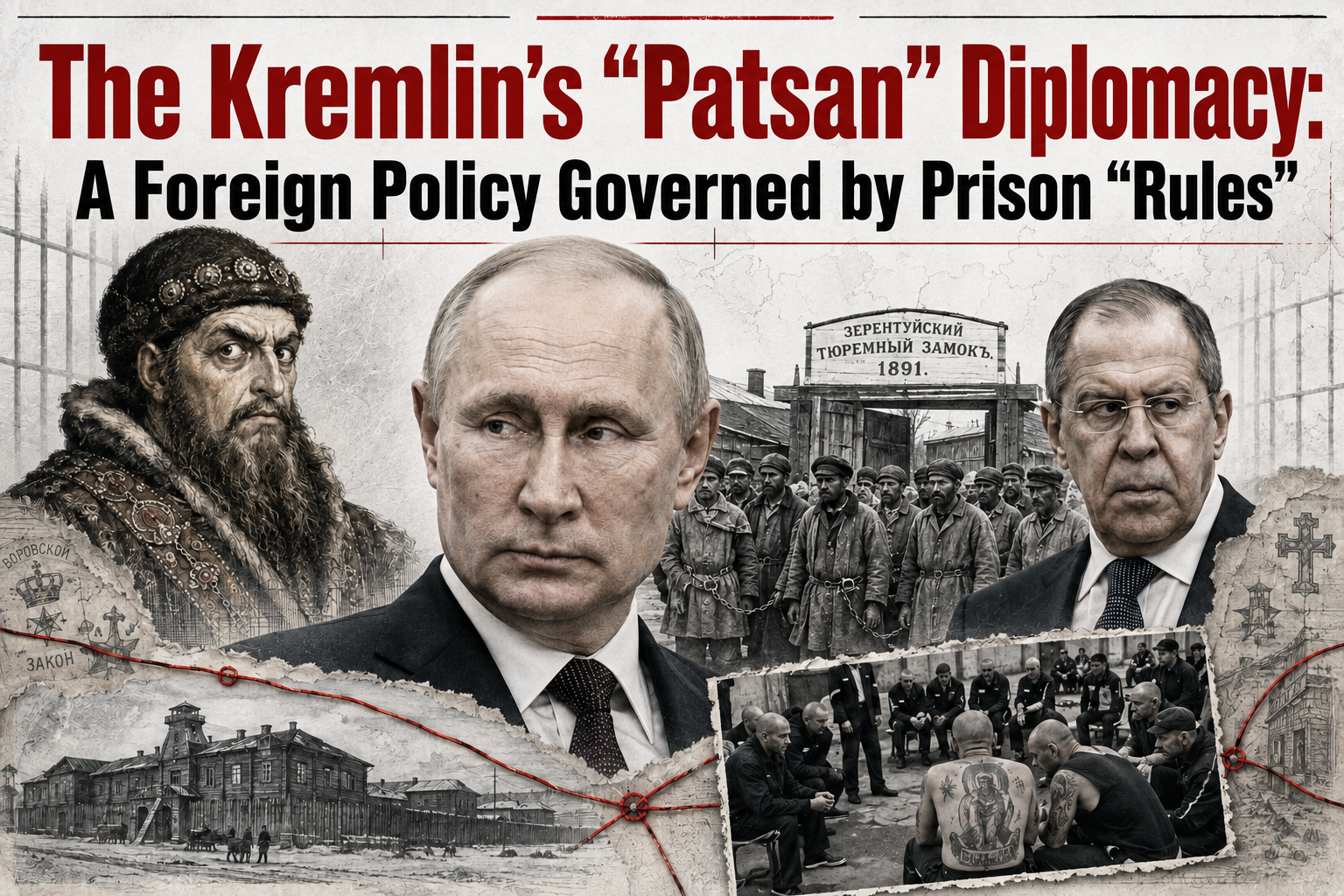
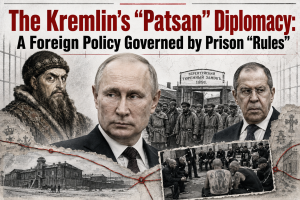
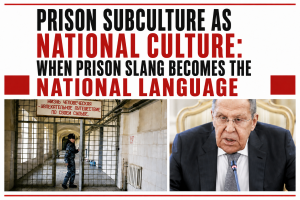
Modern Russian statehood is a unique example, the only one in world history, where, against the backdrop of proclaiming external democratic attributes, the state system is an amazing mix of prison and criminal principles of governance. As a result, the entire domestic policy of the Russian empire is based on connections between the state and the criminal world that are completely uncharacteristic of Western Europe, for example. The main idea is that in order to effectively govern this state, it is necessary to apply the same criminal or prison informal laws. In fact, this state must be governed as one large prison with informal castes, informal concepts (rules), a common fund, and all the characteristics of a modern Russian prison.
Thirdly, we must not forget what the colonial policy of the Russian Empire entailed. And here it would be a fundamental mistake to limit this to Stalin’s gulag, Stalin’s repressions and everything related to the abstract category of the gulag, which the vast majority of Western researchers are inclined to do. Yes, it was certainly during Stalin’s time that the Soviet empire demonstrated an unprecedented number of prisoners, prisons and the penetration of prison subculture norms into society. This led to the transformation of society into one large collective of prisoners, which needed to be managed precisely through prison norms.
However, we must not forget that from the very beginning, when the Moscow principality began its colonial expansion beyond the Urals and started to develop Siberia, it consistently and completely destroyed a huge number of indigenous peoples and used them for further colonisation. An example of this, again, can be found in modern Ukraine: the use of military units from Buryatia and Tyva as cannon fodder and the imposition on these units of an unfounded aura of endlessly cruel punitive formations. All this began in the 15th–16th centuries, when Russia began to develop vast eastern territories.
As noted in previous articles, the main principle was as follows: in order to develop vast territories in the absence of a state apparatus, funding for the ramified network of this apparatus, and when the main population consists of convicts and exiled criminals, it was only necessary to create intermediate links to manage this collective. It was necessary to give informal leaders of prisoners the levers of influence and management tools so that they could create their own quasi-state vertical of management. This happened in parallel with the creation of the state apparatus.
Similarly, from the very beginning, the army, despite its Soviet-style gloss and talk of high officer honour, was prone to violence, to a phenomenon already widespread in the West under the category of hazing.
At the same time, both Western and domestic scholars often forget who created the very code of thieves in law, who created these informal concepts, known to many researchers and even people at the level of Hollywood films about the Soviet gulag. These are former White officers, officers of the Russian Imperial Army.
In addition, the uniqueness of the situation that occurred during the Russian invasion of 2022 lies in the fact that due to the injection of prisoners who were given carte blanche to use torture, the already low level of tolerance for torture in the Russian army (at the level of hazing, where there was still a certain reasonable limit) was completely destroyed after the large-scale injection of Russian prisoners who were initially recruited through the Wagner PMC and then through Storm-Z or Storm-V.
Finally, the creation of an additional artificial hierarchy of Russian military units (i.e., elite units, contract soldiers, ‘mobiki’, former prisoners released for the purposes of war in Ukraine) has created a completely new layer of relations in the modern Russian Empire for managing this post-colonial, post-imperial monster. This monster cannot stop and switch to democratic principles of governance until the subject of power ceases to exist within these same borders. In fact, it can be predicted that the only way out of this endless cycle for many subjects of the Russian Federation is to divide Russia into a sufficiently large number of subjects on a national basis and restore the status quo that existed before the 15th century.