“Proper” Torture: How Ukrainian Society Is Learning to Justify Torture, or the Case of the Odesa Detention Center as a Window into the Abyss

The incident that occurred in the Odesa pre-trial detention centre (SIZO) and that, in a very strange way, came to light and drew the attention of the entire society, is telling and extremely important. Not because it is unique – on the contrary, because it is mundane. It demonstrates the abyss that Ukrainian society has come to face with respect to the supposedly absolute prohibition of torture.
I deliberately make a point at the very outset that ought to be superfluous, but under present conditions is not: this text cannot, in any dimension, be construed as support for the territorial recruitment centres (TCCs) in those of their actions that constitute crimes and gross violations of the law. I write this as an advocate whose client was himself recently unlawfully deprived of liberty by a territorial recruitment centre; as an advocate who conducts administrative cases against the TCCs. My position on the crimes committed by TCC officials therefore needs no explanation – it is unequivocal.
But this post is not about the TCCs. It is about something far more dangerous: about the fact that society has simultaneously and unanimously demonstrated a readiness to justify torture, provided that the torture is applied – in quotation marks – “to scumbags.” About the idea that “proper” torture inflicted on villains is not merely permissible, but just and even desirable. This is precisely my central message.
What, in fact, happened
First, the facts – because it is in their juxtaposition that the essence of the problem lies.
Officers of the State Bureau of Investigation (SBI) exposed, in one of the district territorial recruitment and social support centres of the Odesa region, a large-scale scheme of unlawfully coercing citizens into mobilisation. In order to improve conscription figures, officials of the institution unlawfully held men on the centre’s premises, beat them, intimidated them, and exerted psychological pressure. The investigation also established individual instances of acts of a sexual nature of a violent character committed against the victims. Six TCC employees were assisted by three representatives of a local civic organisation, who tracked down citizens and gathered information about them. Nine members of the group were detained; they were notified of suspicion of torture, unlawful deprivation of liberty, and robbery committed by an organised group. The court chose a preventive measure in the form of detention in custody without the right to post bail.
This is torture. The SBI called it torture. The law calls it torture. And that is correct.
A PARALLEL EVENT
On social media, the public association “Non-Stop Ukraine” published a video, filmed, presumably, in the Odesa SIZO, showing a man – allegedly that same TCC employee – being forced to crawl on the floor, to perform dog commands, and to carry slippers in his teeth to other inmates. The commands were given to him by the so-called “overseer” (smotryashchiy) of the block. The State Criminal-Executive Service confirmed the opening of an internal inquiry, the management of the Odesa SIZO was suspended, and the SBI opened proceedings.
And here is the most important point. This second event was almost unanimously labelled by the media, officials, and society as “abuse” and “humiliation.” Not torture. Merely “abuse.” And it is precisely in this substitution of words that the entire machinery of legitimisation is concealed.
THE TWOFOLD MOVEMENT OF PUBLIC CONSCIOUSNESS
When the SBI exposed the group of TCC employees, society exploded. But it exploded not with indignation against torture as such. It exploded with popular vengeance.
In the mass reaction, two movements occurred simultaneously, which only at first glance appear unrelated.
The first movement is the demonisation of the TCC employees. This is understandable: particular officials who tortured and robbed citizens for the sake of figures deserve the response prescribed by law. But demonisation is not justice. Demonisation transforms a specific human being from a suspect, protected by the presumption of innocence, into an abstract “villain” with respect to whom, supposedly, “anything goes.”
The second movement is the whitewashing of the staff of the Odesa pre-trial detention centre – or, more precisely, of those who organised and permitted the torture of an inmate within the walls of a state institution. The treatment applied to the detained TCC employee was, in effect, recognised by society as lawful and just. “He deserved it.” “Serves him right.” “Justice at last.” Torture carried out by inmates under the tacit supervision of the SIZO administration was turned into an instrument of popular vengeance – and, in that capacity, approved.
This is where the catastrophe occurs. For the very same torture that society rightly condemns when it is inflicted by TCC employees is the one it welcomes when it is inflicted in the SIZO – against the “right” victim.
“ABUSE” OR TORTURE? ON THE SUBSTITUTION OF WORDS
Note the language. What the SBI defendants did is “torture.” What the staff of the Odesa pre-trial detention centre did is merely “abuse” or “humiliation.”
This is neither coincidence nor journalistic carelessness. This is legitimisation in action.
Forcing an adult to crawl on their knees, to perform dog commands, to carry footwear in their teeth to other prisoners – this is not “abuse” in the everyday sense of the word. This is classic degrading treatment, and in terms of its intensity, systematic character, and purpose it is torture within the meaning of Article 3 of the Convention for the Protection of Human Rights and Article 127 of the Criminal Code of Ukraine. For decades the European Court of Human Rights has qualified precisely such acts – humiliation that destroys the personality, that places a person in the position of an animal – as a violation of Article 3 of the Convention.
When we call torture “abuse,” we make the first and most important concession. We soften the word in order to soften the act, in order ultimately to soften the prohibition. The lowering of the threshold of torture begins right here – in the vocabulary.
The most dangerous idea of contemporary Ukraine: “proper” torture
Let me state plainly what hangs in the air and what no one dares to say aloud: the idea has taken hold in society that torture is acceptable if it is applied to a villain.
This is the idea of a conditional, selective, “just” prohibition of torture. The idea that torture is a tool that is bad in the wrong hands, but good in the “right” hands, against the “right” objects.
This is a direct and absolute negation of the very concept of human rights.
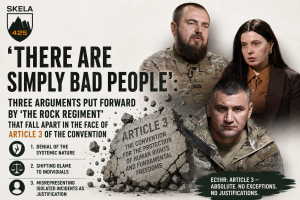
For the prohibition of torture is absolute. It knows no exceptions. Article 3 of the Convention is one of the few that is not subject to any derogation, even in conditions of war or a state of emergency. No exceptional circumstances – neither war, nor the threat of war, nor internal political instability, nor any other state of emergency – can serve as a justification for torture. None. Never. Against no one.
And here it is worth recalling two circumstances that are forgotten in the heat of popular vengeance.
First, the person who was tortured in the SIZO had not been convicted. No verdict has been rendered against him. He is a suspect, nothing more. The presumption of innocence is not a formality for advocates’ speeches, but a load-bearing element of the entire edifice of law.
Second – and this is fundamental – even if a verdict is rendered, even if guilt is fully proven, this in no way justifies torture. A convicted murderer, rapist, torturer – all of them retain the right not to be subjected to torture. Not because they “deserve” it, but because the prohibition of torture protects not them – it protects us. It protects the very idea of human dignity, which cannot be taken away for any guilt. A society that agrees to torture “villains” very quickly discovers that the circle of “villains” expands, and that who falls within it is decided not by a court.
“AND IMAGINE WHAT THEY DO TO THE REST”
And the final, coldest thought. The acts permitted against the TCC employee were carried out languidly, openly, without concealment, with absolute cynicism – so much so that they were filmed on video. If such things are done for show, without hiding, to a person whose case is guaranteed to become public – imagine what is happening within the walls of that same Odesa SIZO to those whose names no one will ever learn. To those for whom there is no one to stand up. To those whose humiliation no one will film on a phone and post online.
This is precisely why this case is so important. It is not an exception, but an indicator. It shows not that a cruel “overseer” has appeared in one block, but that an entire system tolerates, uses, and tacitly approves torture – on condition that the victim is the “right” one.
THE INSTITUTIONAL RESPONSE: A MACHINE OF BUREAUCRATIC BRUSH-OFFS
I did not confine myself to observations. I addressed the authorities – the State Bureau of Investigation, the Office of the Prosecutor General, the Odesa regional and district prosecutor’s offices, the Ministry of Justice, the SIZO institution itself, and the relevant interregional directorate – with a consolidated request and a statement concerning possible criminal offences in the conditions of the Odesa SIZO.
What did I receive? Brush-offs. In their purest, laboratory-pure form.
The Office of the Prosecutor General forwarded my statement “by territorial jurisdiction” to the Odesa regional prosecutor’s office – and notified me of this. By another letter the OPG forwarded the appeal “by competence” and kindly explained that I could appeal the actions of the investigator or prosecutor under the procedure of Articles 303–310 of the Criminal Procedure Code. The Khadzhibey district prosecutor’s office of the city of Odesa forwarded my information requests further on and separately noted that it “is not the proper holder of the requested information.”
Not a single body said, “Yes, we are looking into this, here is what has been done.” Each one said, “This is not quite for us” – and redirected it further round the circle. A torture complaint is passed between instances like a hot potato, until it cools down and gets lost.
Here it is, the institutional cover of that same legitimisation. Society approves torture from below – and the state evades reacting from above. Both lead to the same point: impunity. And the impunity of torture is not a side effect. It is, according to the entire case-law of the ECtHR and the European Committee for the Prevention of Torture (CPT), a separate and self-standing violation, because it is precisely impunity that makes torture systemic.
IN LIEU OF A CONCLUSION: ON THE PRESENT, TO WHICH NO ONE PAYS ATTENTION
I do not wish to write at length in this post about the absolute prohibition of torture as a legal doctrine – it is obvious enough to anyone willing to see it. I want all the experts, civic associations, civic initiatives, and organisations that speak about human rights every day to finally reflect on what sounds mundane today and to which no one pays attention.
The lowering of the threshold of torture and the maximal, absolute heightening of tolerance toward torture have already become our present. The Odesa case is merely an example, a litmus test, a flash that for a moment lit up the abyss.
The most terrible thing about torture is not the act of violence itself. The most terrible thing is the moment when society begins to approve of that violence. When “never, against anyone” quietly turns into “permissible, if he deserved it.” Because after that, the question is no longer whether there will be torture. The only question is who will be the next to be deemed to have “deserved” it.