In Memory of Yevhen Hrytsiak: The 100th Anniversary of the Birth of the Leader of the Norilsk Uprising
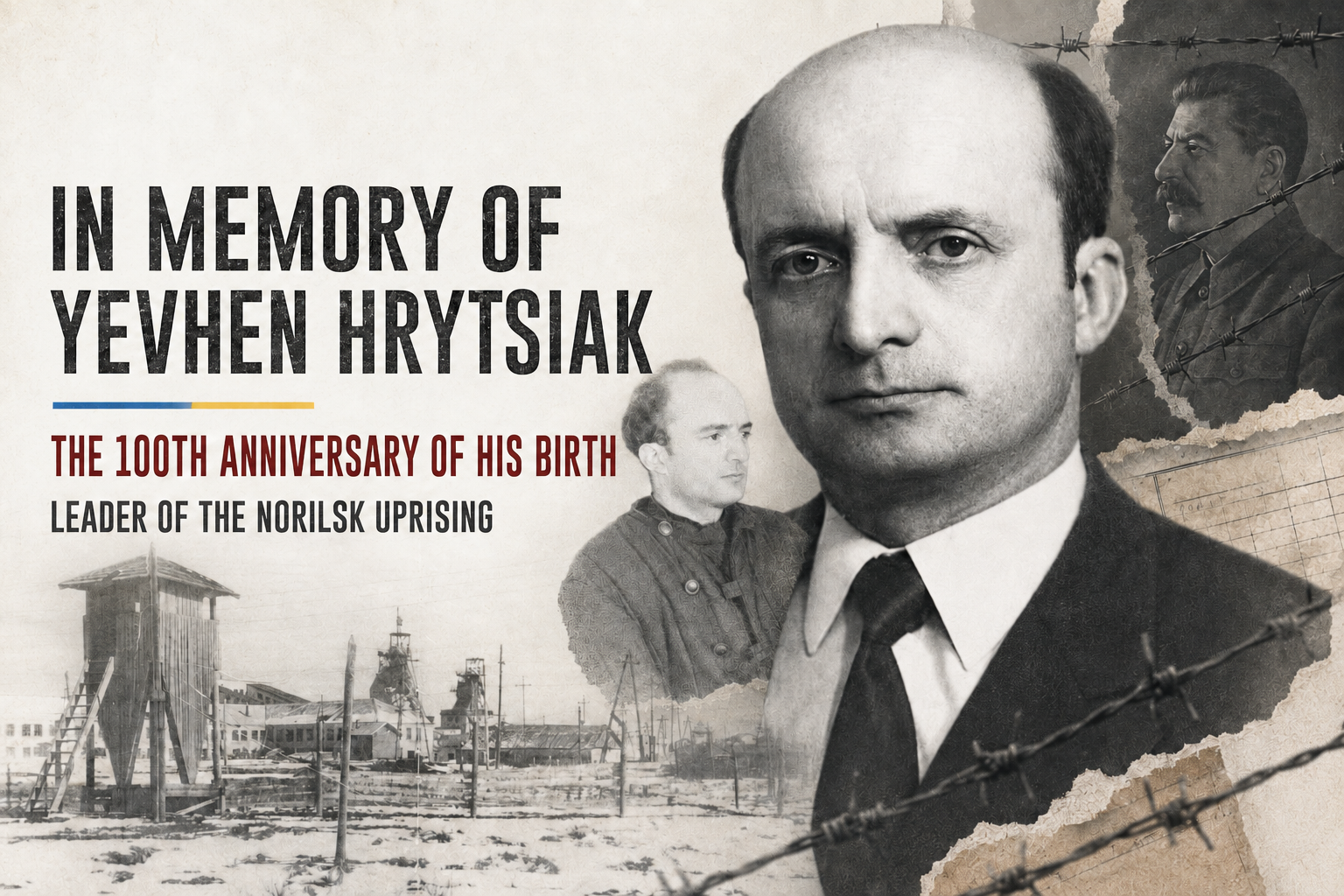
On 9 August 2026, Yevhen Stepanovych Hrytsiak turned one hundred years old – a native of the village of Stetseva in the Sniatyn district, a member of the OUN Youth Network, a frontline soldier severely wounded in the battles of the 4th Ukrainian Front, and at the same time a political prisoner sentenced in 1949 to death, commuted to 25 years in the camps.
It was under this status, bearing the camp nickname “Poltavets,” that Hrytsiak passed through Dzhezkazgan, the Vladimir Central Prison, the Taishet line, Inta, and Mordovia — and Norilsk, where his name was forever inscribed in the history of resistance to the Soviet repressive system.
In the summer of 1953, shortly after the death of Joseph Stalin, when political prisoners’ hopes for amnesty turned into disappointment, an uprising broke out in the camps of Gorlag that lasted from 26 May to 4 August and became the longest and largest prisoner uprising in the entire history of the Gulag. It was triggered by the killing of prisoners by the guards; the result was a strike that engulfed nearly 17,000 people across several camp sections at once. Yevhen Hrytsiak was among those who joined the strike committee and helped formulate the insurgents’ demands: review of investigative case files, release of underage convicts, reduction of the working day, removal of camp numbers, and a ban on shooting into the work and residential zones.
More than 70% of Gorlag’s political prisoners were Ukrainians — and it was above all people from the western Ukrainian national liberation underground who, according to researchers, built the structure of resistance in the camps in the most organized and consistent way.
The Norilsk uprising was suppressed by force — according to various estimates, the death toll reached as many as a thousand people. But its significance extended far beyond a single summer and a single camp. Together with the parallel uprising in Vorkuta and, later, the 42-day uprising in Kengir in 1954, it demonstrated the very thing the Soviet system feared most: that political prisoners were capable of organized resistance, not merely of dying in silence.
These events triggered personnel rotations in the Gulag’s leadership, forced a softening of the camp regime, and — most importantly — set in motion a process that ultimately undermined the foundations of the Stalinist camp system as an instrument of state governance. The camp uprisings of the mid-1950s did not merely precede de-Stalinization — they were one of the factors that made it inevitable: the crisis of controllability of the repressive machine, caused by the mass, coordinated resistance of prisoners, became an internal engine of change in Soviet penitentiary policy and, later, more broadly, in the regime itself. The camp revolt of the 1950s marked a new epoch of the Archipelago — an epoch that eroded it from within.
After his release in 1956, Yevhen Hrytsiak settled in Karaganda, since he was forbidden to return to Western Ukraine; he later devoted his entire life to preserving the memory of what he had lived through, writing a memoir about the Norilsk uprising that became one of the fundamental primary sources for researchers on the subject. He died on 14 May 2017 in the village of Ustia in the Ivano-Frankivsk region.
The 100th anniversary of Yevhen Hrytsiak’s birth is an occasion not only to honor a particular individual but also to remind ourselves: history shows that even the harshest repressive systems prove vulnerable to organized and sustained resistance from those they seek to permanently silence. The camp uprisings of the 1950s — the Norilsk uprising in particular — remain compelling evidence that resistance to unfreedom can become a driving force of historical change.