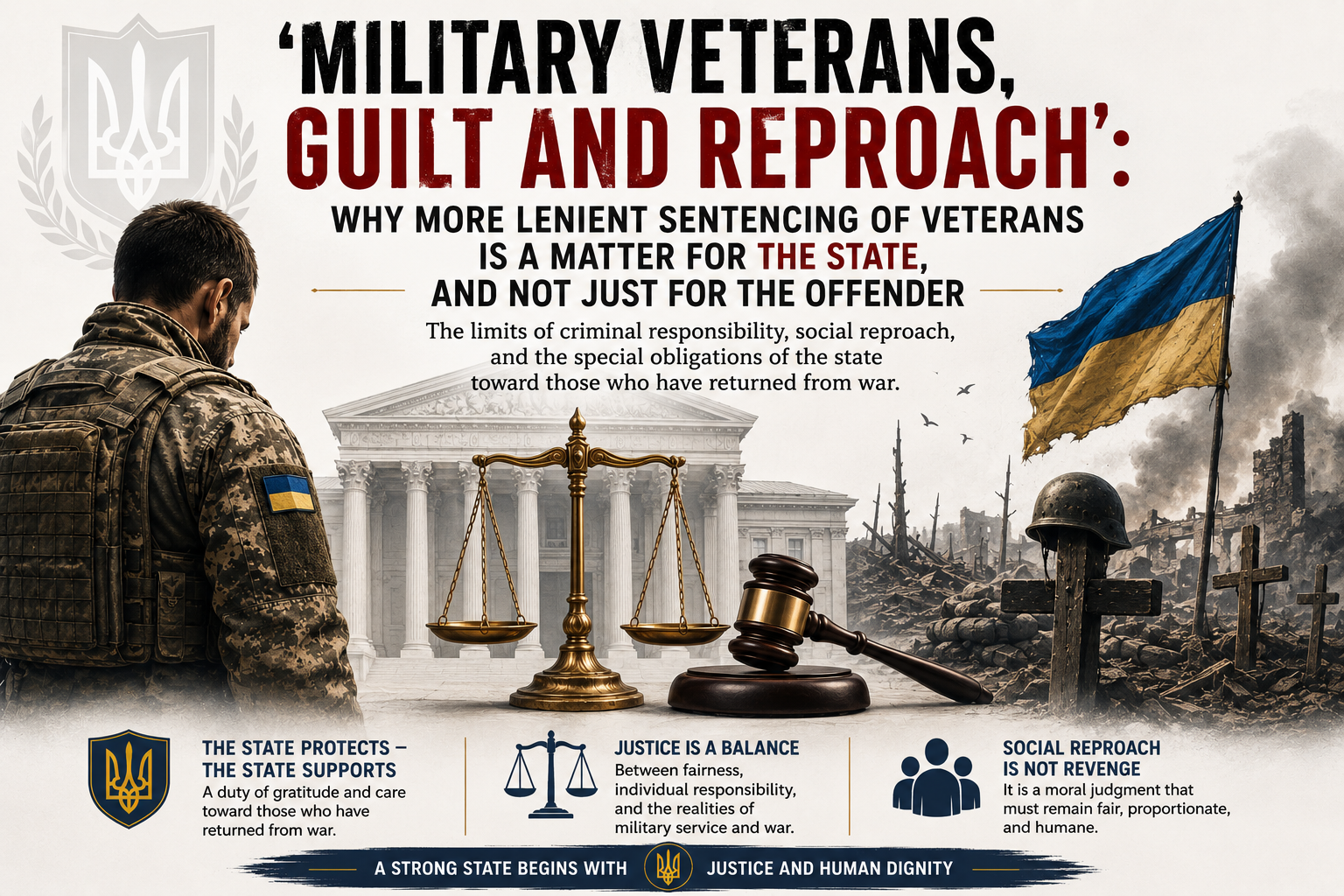
‘Military Veterans, Guilt and Reproach’: Why a More Lenient Sentencing of Veterans is a Matter for the State, and Not Just for the Offender
We bring to the attention of judges hearing cases involving veterans a work of legal theory – the article by Youngjae Lee (Fordham University School of Law), Military Veterans, Culpability, and Blame (2013). It does not operate with statistics on recidivism or the prevalence of PTSD, but poses a more fundamental question: on what basis is the state entitled to convict a veteran-offender at all – and does it retain the full moral right to do so.
For the Ukrainian judiciary, the topic has ceased to be an academic abstraction. The return of a significant number of veterans to civilian life makes the question of individualising punishment in their cases one of the most acute in practical terms – and it is precisely here that Lee’s optics offer an unexpected angle.
The article analyses – from the standpoint of retributivism (just deserts) – the grounds for the state’s mitigated conviction of veterans who have committed crimes, taking as its point of departure the US Supreme Court’s decision in Porter v. McCollum on the “long tradition of according leniency to veterans” (Lee, 2013).
The author identifies two typical justifications for differentiated treatment – a “social-contribution discount” (gratitude for service) and a “mental-disorder discount” (such as PTSD resulting from combat stress) – and casts doubt on both (Lee, 2013).
Instead, Lee advances his own thesis: a veteran-offender deserves lesser blame not because of diminished mental capacity or social merit, but because the state’s own complicity in shaping his criminogenic disposition undermines its moral standing to reproach him (Lee, 2013). In this way the article shifts the focus from the characteristics of the offender to the legitimacy of state condemnation.
Having adopted the working assumption that PTSD generally reduces the capacity to control one’s behaviour and therefore diminishes culpability, Lee immediately introduces a key limitation – the source of the trauma matters:
PTSD does not reduce culpability if the symptoms stem from the person’s own culpable conduct – by analogy with actio libera in causa and the principle of Riggs v. Palmer (“no one may profit from his own wrong”). The illustration is trauma acquired as a result of murders or rapes committed by the subject himself.
PTSD does not mitigate if it arose from the veteran’s violation of the principles of jus in bello – that is, from atrocities (the deliberate killing of civilians, the torture of prisoners).
PTSD does not mitigate if it can be traced to participation in an unjust war (jus ad bellum) – save where the soldier genuinely and reasonably believed the war to be just.
Even then, the person should not be punished to the full extent, because the state, being complicit in generating his criminality, loses the moral right to reproach.
The most original part of the article is the argument concerning the state’s responsibility. The state exercises violence through the hands of soldiers as its agents, places them in criminogenic conditions, cultivates an ethos of unconditional obedience, and purposefully overcomes the natural reluctance to kill (Lee invokes the research of S. L. A. Marshall, according to which only 15–20% of soldiers consciously fired at the enemy). All of this, in the author’s view, undermines the state’s moral right to reproach a person for the consequences of a mental state that the state itself shaped – even in a just war. The exception is atrocities: by violating jus in bello, the soldier steps beyond the violence sanctioned by the state, and in that case the state retains its right to reproach.
The value of the article for a judge lies not in ready-made prescriptions but in a methodological shift: it moves the conversation from the plane of “how ill or how deserving the defendant is” to the plane of “how legitimate is condemnation by the very state that sent him there”.
At the same time, direct transposition calls for caution. Lee works within the framework of American retributivism and proceeds from Porter v. McCollum; in our context his third thesis (the unjust war) rather underscores the opposite – the defensive, lawful character of the participation of Ukrainian servicemen, which weakens rather than strengthens the ground for a “contribution discount” in its problematic reading.
The central argument, by contrast – concerning the standing of a state that placed a person in the criminogenic conditions of combat – retains its force regardless of the justice of the war. It is precisely this that makes Lee’s framework suitable for a balanced discussion of the individualisation of punishment, rather than for automatic “discounts”.
Finally, the question that Lee poses in the language of retributivism translates fully into the language of proportionality of punishment as well – and therefore resonates with the standards of the Convention and the case-law of the ECtHR.