‘Is There Any Chance of a “Deal” on Ukraine?’: The Russian Liberal Opposition as a New Imperial Force, or Why Russia’s Future Begins with Decolonisation
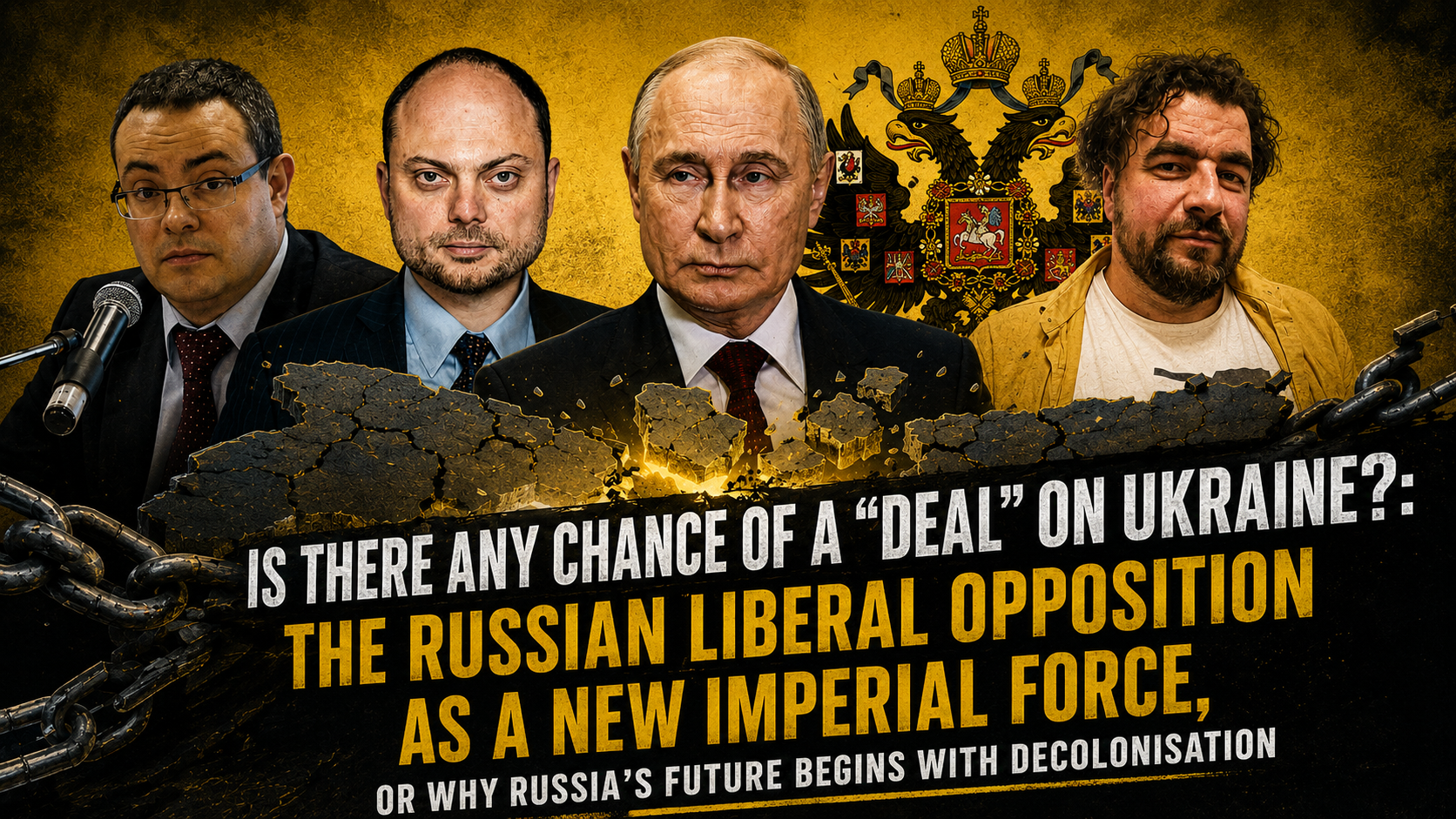
Vladimir Kara-Murza talked with Russian opposition political scientists about a “deal” on Ukraine. This interview is useful but not because of what they say about Putin. About Putin, they say everything right: they call his rule fascist, the war a crime, and the Kremlin’s defeat a good thing. The interview is useful for another reason. Without meaning to, it shows the inner logic of the Russian liberal opposition. And this logic is still imperial, even when the words have become anti-Putin.
This is the main trap of the moment. The world has got used to splitting Russians into “bad” and “good” by one thing only: how they feel about Putin. But “for Putin / against Putin” is not the same line as “empire / post-empire.” You can truly hate the dictator and, at the same time, keep the same imperial way of seeing the world — the very way of seeing that created this dictator. This is exactly what the talk on “Ekho” shows.
AN EMPIRE THAT SPEAKS AS “WE”
Let us look at who is the main actor in this talk. The whole show turns around one question: “what will happen to Russia.” Will the regime fall, will it “crack,” will it “remake itself.” Ukraine is there mostly as a tool. Its strikes, and the open letters from the Russian elite, matter only because they can start a change inside Russia. The call for “more strikes and more open letters” says a lot. Ukraine’s fight is not seen as a people’s own fight for its life, its land, and justice. It is seen as a useful trigger for a Russian inner process.
Again and again they say “our history,” “our Russian history.” In this frame, the moral center of the world is still Russia’s own renewal. The war is bad first of all because it is bad for Russia’s growth. This is not a slip of the tongue. It is a whole way of thinking: Russia is the actor of history, and everyone else is just part of its story.
PEOPLES AS A THREAT, NOT AS ACTORS
The imperial reflex shows most clearly when they talk about Russia maybe falling apart. They speak about this almost only as chaos and danger that must be “managed”: a region with its own army and nuclear weapons, led by some “crazy guy you can’t understand”; a clash between Bashkortostan and Tatarstan over land. The right of colonised peoples to decide their own fate is not even named here as a fair question. From the start, it is written down as a “risk.”
This is a classic imperial way of thinking: the empire must hold together, because if not, there is an abyss; colonised peoples cannot be trusted with their own state. To this they add a look-down on the “deep country,” which supposedly “watches in surprise” — the people as a passive mass, an object of history, not a part of it. This is how the empire looks at its edges, even through the mouths of people who are against the Kremlin.
“THEY WILL CALL US ALL BACK FROM EXILE”
Here is another sign. They simply assume that the future “reset” of Russia will be done by “all of us and Russian liberals of every kind.” In other words, the future of this space belongs, by default, to Russian liberals in exile. This is a reflex of restoration: they see themselves as the rightful owners of the land, pushed out for a while by a usurper, but, deep down, still the masters of the house.
It is not by chance that they bring up the “principle of non-predetermination,” an idea from the thinkers of the White movement — the movement for “one and indivisible Russia,” that is, a clearly imperial and restorationist force. Where their ideas come from says more than their statements. They also lean on Solzhenitsyn and his idea of “blessed defeats.” This completes the picture: the goal is to bring great Russia back to life, not to take the empire apart.
BEING ANTI-PUTIN IS NOT YET BEING ANTI-IMPERIAL
Let me be clear, so this is not made too simple: these people are not Putinists. They seem to be on the side of the Kremlin project’s defeat, they seem to condemn the crimes, and some of them even warn against easy comparisons and admit that Russian society still has a long road before it faces what was done. These are important and honest words.
But this is exactly why the case matters so much. Here we have the best and most thoughtful part of the opposition — and even it thinks of the space of the old empire as one single field, where Russians (even liberal ones) stay the main actors, and the neighboring peoples appear only as a part of Russia’s path or as a source of threats. This is not the imperialism of rule. It is the imperialism of the way of seeing. And it is this that is dangerous, because it hides behind a democratic alternative and claims to be the future face of Russia.
If Putin’s regime changes tomorrow but this logic stays the same, we will not get a post-imperial Russia. We will get an empire with a liberal front — one that will again speak of “zones of influence,” “a shared space,” “brotherly peoples,” and “non-predetermination,” that is, the right to decide the fate of its neighbors from inside Moscow.
DECOLONISATION AS THE ONLY CONDITION FOR THE FUTURE
From this comes a point that must be said plainly. Russia’s future in a dialogue with its neighbors is possible only on one condition: through decolonisation and the conscious killing of imperial ambitions inside Russian politicians themselves, no matter how they feel about Putin.
Here, decolonisation is not a metaphor. It means at least four concrete shifts in the minds of those who claim to speak for “another Russia.”
First, they must give up the position of the one and only actor. Ukraine, like the other neighbors, is not a tool of Russian change. It is an actor in its own right, with its own goals: getting back its land, holding people to account for crimes, and safety. The Russian opposition has no moral right to read someone else’s fight through the lens of its own gain.
Second, they must accept the right of the peoples inside Russia itself to decide their own fate as a fair right, not as a disaster. The Chechens and other peoples of the Caucasus, the Bashkirs, the Tatars, the peoples of Siberia and the Volga region — they are not a “risk of break-up.” They are actors whose will must be heard, not held back in the name of “one and indivisible.”
Third, the future of the post-Soviet space does not belong, by default, to Russian liberals in exile. Their job is to put their own house in order, not to “remake” a space that is not theirs.
Fourth, they must do full, not selective, work with the history of crime: not only Putin’s, but also the imperial and Soviet ones, including admitting that the Russian state itself was colonial by its very nature.
Only such a Russia — a Russia that has freely stopped being an empire in its own head — will be able to talk with its neighbors as an equal with equals, and not as a center that is weak for now and waits for a chance to bring back its “influence.” Until then, any “deal” and any “wonderful Russia of the future” will stay only a delayed form of the same old empire.
The task of Russia’s neighbors — and first of all Ukraine — is not to choose between “bad” and “good” Russians. It is to name the imperial logic clearly where it hides behind liberal words, and to stop a new imperial force from using anti-Putinism as a pass into the future.