Fatima Souleimanova: When the Chechens Shattered the Myth of Russian Invincibility
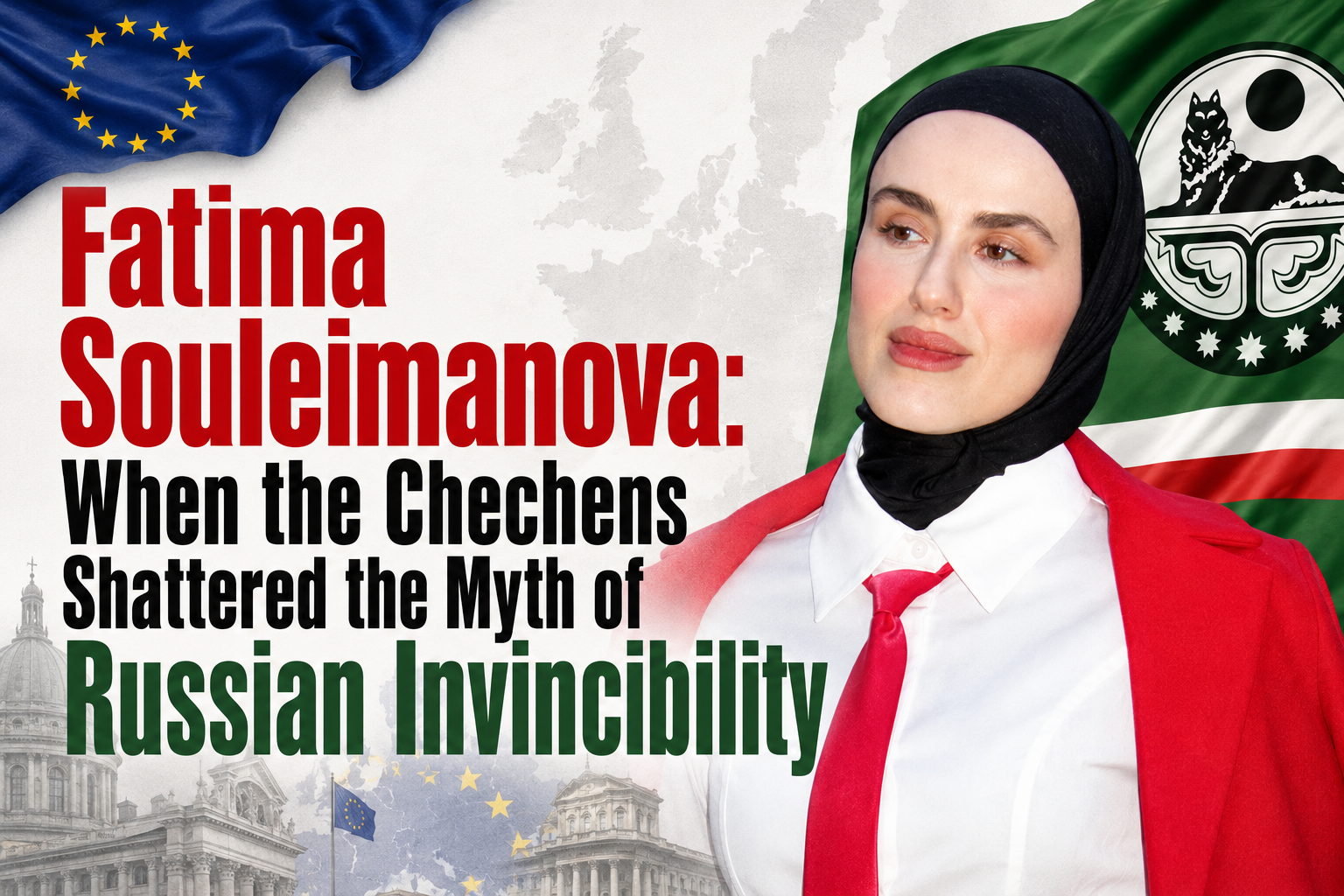
Today, thirty years after the Chechen victory over Russian military aggression, it is essential to revisit an episode that remains more relevant than ever. At a time when Russia continues its war against Ukraine and poses an increasingly serious threat to European democracies, this chapter of history remains largely unknown. August 6, 1996, marks a decisive date not only in the history of the Chechen people, but also in the history of my own family: my father and my two uncles took part in the operation to retake Grozny. The purpose of this op-ed is to explain why this victory extends far beyond the Caucasus and is of direct relevance to Europe. To do so, it is necessary to bring the Chechen perspective to light – a perspective long overshadowed by the Russian narrative – and to restore a history told almost exclusively by the aggressor, while the voices of Chechen resistance fighters have been silenced for more than three decades.
The Chechen victory of 1996 against an overwhelmingly more powerful invader remains an exceptional case in modern military history. To understand how the Chechens managed to inflict such a devastating defeat on the Russian army, it is first necessary to examine the origins of the conflict.
Long before the Caucasian War of the nineteenth century, Russia was already conducting regular military expeditions against the Chechens in an attempt to subjugate them and pave the way for its expansion into the North Caucasus. These early campaigns, however, ended in repeated failure. At the beginning of the nineteenth century, this imperial ambition culminated in a large-scale campaign of conquest across the Caucasus, marking the outbreak of the Caucasian War. At the time, the Russian army was already regarded as one of the most powerful military forces in the world. Yet the very army that had defeated Napoleon remained bogged down in the region for nearly half a century, unable to subdue the mountain peoples. Among them, the Chechens emerged as one of the principal forces resisting Russian expansion. At the end of the conflict—the longest war ever fought by Russia – Chechnya was forcibly incorporated into the Russian Empire.
This conquest, however, did not bring an end to the uprisings. The Chechens continued to resist, enduring successive waves of repression under the Imperial, Soviet, and later Russian Federation regimes. The most tragic episode occurred on February 23, 1944, when Joseph Stalin ordered the deportation of the entire Chechen population to Central Asia. This event remains deeply embedded in the Chechen national memory. French historian Stéphane Courtois has described it as “the largest deportation operation in world history”.
The violence inflicted by Russia and the Chechens’ enduring capacity for resistance are rooted above all in the profound contrast between two fundamentally different political cultures.
Chechen political philosophy is founded on the primacy of the individual, from which stem the principles of freedom, dignity, and personal responsibility. Chechen society has traditionally been egalitarian. It operates through a system of local self-government and is collectively organised to resist any form of external domination.
By contrast, Russian political culture has historically developed around a highly centralised hierarchy, a vertical structure of power, and a logic of imperial expansion based on military conquest.
Europe often views Chechnya as a distant land, disconnected from its own history and values. Yet in many respects, the principles that have shaped Chechen society for centuries – the primacy of human dignity, equality among the free members of the community, and collective responsibility—bear a closer resemblance to the values upon which Europe’s democracies were built than do the principles that have historically shaped Russian political culture.
Describing the Chechen declaration of independence, at the time of the collapse of the Soviet Union, as a mere “secession” therefore not only erases centuries of Russian colonisation and Chechen resistance, but also adopts the interpretive framework imposed by Moscow. Even unintentionally, such terminology contributes to the dissemination of Russian propaganda. This analytical error facilitated the rise and subsequent consolidation of Vladimir Putin’s regime, which represents not a break with the Russian political system, but its continuation. If Europeans continue to make the same analytical mistake today, the consequences will be even more severe.
As the Soviet republics, such as Ukraine and Georgia, gained independence, Chechnya became the only autonomous republic to follow the same path by invoking the principle of the right of peoples to self-determination. It therefore declared its independence in 1990, even before the Russian Federation officially came into existence. Chechnya also remains the only political entity that never signed the Federal Treaty establishing the Russian Federation. This clear understanding of the true nature of the new Russian state – viewed as a continuation of the Soviet system – and the warnings its leaders addressed to the international community once again came at a heavy cost.
On December 31, 1994, Boris Yeltsin ordered the restoration of what he called “constitutional order” in Chechnya. The Russian army launched its assault on Grozny, turning the city into the scene of one of the most devastating battles fought in Europe since the Second World War. The war claimed hundreds of thousands of Chechen victims, was accompanied by widespread repression, and left cities and villages in ruins.
Confidence in Moscow was absolute. Russian Defense Minister Pavel Grachev declared that a single airborne regiment would be enough to defeat Dzhokhar Dudayev, the first President of the Chechen Republic of Ichkeria, within a matter of hours. Reality proved very different: the intervention ended in a humiliating defeat for Russia, a humiliation that would, a few years later, fuel Vladimir Putin’s determination to exact revenge.
At dawn on August 6, 1996, the armed forces of the Chechen Republic of Ichkeria launched the operation to liberate Grozny. They consisted primarily of young men who had no military experience before the outbreak of the war and had volunteered to defend their country.
For many months, the capital had been completely encircled and occupied by forces of the Russian Ministry of Defense, the Ministry of Internal Affairs (MVD), and the Federal Security Service (FSB). For the Russian authorities, the prospect of the Chechens recapturing Grozny was simply inconceivable.
The Chechen forces numbered only between 800 and 1,200 fighters, facing approximately 10,000 to 12,000 Russian troops supported by tanks, armoured vehicles, aircraft, artillery, and virtually unlimited ammunition reserves. Such an overwhelming imbalance of forces made a Chechen victory appear almost impossible.
The strategy devised by the Chechen command was based on an entirely different logic. Rather than launching a frontal assault, Chechen fighters infiltrated Grozny discreetly in small groups, advancing simultaneously from multiple directions. They bypassed the main Russian checkpoints, struck Russian units stationed throughout the city with speed and precision, and then severed their lines of communication and the routes through which reinforcements could arrive. The objective was not to destroy the Russian army through brute force, but to fragment its units, isolate them from one another, and prevent them from providing mutual support.
The Russian forces were caught completely off guard by both the speed and the scale of the offensive. Russian intelligence had failed to detect the preparations for an operation of such magnitude. Within the first hours of the fighting, the federal command lost all situational awareness. While Russian generals were still trying to understand what was unfolding, Chechen commanders had already seized complete operational control. The Russian command proceeded to make one mistake after another. Convinced of their overwhelming superiority, military leaders underestimated their opponent. Their units were dispersed across the city and operated under separate chains of command. Forces from the Ministry of Defense, the Ministry of Internal Affairs, and the other security services struggled to coordinate their actions effectively.
It was precisely this ability to impose their own rules of engagement on the enemy that became one of the decisive factors behind the Chechen victory.
The few hours that the Russian Minister of Defense had arrogantly claimed would suffice to crush the Chechen resistance proved far from enough. Instead, it took only a matter of days for Chechen fighters to compel the Russian forces to accept a ceasefire and surrender their weapons in exchange for safe passage out of Grozny.
Beyond its military significance, the defeat inflicted a profound psychological shock on Russia. The August 1996 operation not only transformed the situation on the battlefield but also dealt a severe blow to the Kremlin’s political strategy. For the first time, Moscow was forced to negotiate.
These negotiations culminated in the signing of the Khasavyurt Accords on August 31, 1996, by Aslan Maskhadov, Chief of Staff of the Chechen armed forces, and Alexander Lebed, Secretary of the Russian Security Council. The agreement officially brought the First Russo-Chechen War to an end.
A few months later, on May 12, 1997, a peace treaty was signed in the Kremlin by the newly elected Chechen President Aslan Maskhadov and Russian President Boris Yeltsin.
The peace, however, proved short-lived. The Russian authorities appeared never to have intended to honor these commitments over the long term. Before long, the prospect of taking revenge became firmly embedded within the Russian leadership.
In September 1999, a series of apartment bombings struck several Russian cities. The Russian authorities blamed the attacks on the Chechens and used them as the justification for launching a new war. These events remain highly controversial, however, as some have accused the Russian security services of orchestrating the bombings in order to provide a pretext for military intervention.
Vladimir Putin presented this new military campaign as a “counterterrorist operation”. Under that label, the Second Russo-Chechen War was marked by numerous violations of international humanitarian law, documented by several human rights organisations.
The terrorist attacks of September 11, 2001, profoundly altered the international context. The global “War on Terror” enabled the Kremlin to frame its intervention in Chechnya within a narrative that was widely accepted by part of the international community. This shift significantly reduced international criticism of Moscow and helped strengthen Vladimir Putin’s international legitimacy.
This lack of a meaningful international response facilitated the consolidation of Putin’s regime. According to many observers, the methods first employed in Chechnya were later replicated in Georgia and subsequently in Ukraine.
For this reason, the Chechen question remains particularly relevant in the context of Russia’s ongoing war against Ukraine. Yet although both peoples have resisted Russian aggression, they have not received the same treatment from the international community. While the latter proclaims its commitment to defending the right of nations to live in freedom and sovereignty, it abandoned Chechnya in the face of a war marked by grave human rights violations. At the same time, Moscow gradually succeeded in imposing the narrative of a struggle against terrorism, while the Chechens’ political and national aspirations were increasingly pushed aside. More troubling still, the warnings issued over many years by numerous Chechen political leaders and intellectuals were largely ignored. They had already warned of the increasingly authoritarian trajectory of the Russian state and of the consequences that its impunity could have for Europe. Those voices were progressively silenced, even though they might have enabled Europe to recognize far earlier the course the Kremlin was taking.
Generation after generation, the Chechens have chosen to defend their freedom and their right to determine their own future, despite an immense human cost. Their history reminds us that democracy survives not only through the strength of its principles, but also through the determination of those who refuse to abandon them. Faced with a state that interprets every concession as a sign of weakness and every retreat as an invitation to pursue further expansion, Europe’s democracies can no longer afford to hope that dialogue alone will be sufficient to preserve peace. They must rediscover the resolve to defend the values upon which they were built.
From this perspective, recognizing Russia’s occupation of Chechnya constitutes an essential step toward effectively and sustainably confronting the political system that made this crime possible. On October 18, 2022, the Verkhovna Rada of Ukraine adopted a resolution recognizing the Chechen Republic of Ichkeria as a territory temporarily occupied by the Russian Federation and condemning the Russian occupation. This decision illustrates the continuity that the Ukrainian authorities draw between Russia’s occupation of Chechnya and its ongoing aggression against Ukraine.
History shows that simply changing a state’s name is not enough to transform it permanently if the underlying structures of domination remain intact. As long as the right to self-determination of the peoples subjected to Russian rule remains largely absent from the European debate, the root causes of this instability are likely to persist.
Even if the war in Ukraine comes to an end, and even if Vladimir Putin eventually leaves power, the threat posed by the Russian political system will not necessarily disappear. Lasting peace also requires a broader reflection on the mechanisms that have allowed these conflicts to recur.
The Chechen victory of 1996 demonstrated that the Russian army is not invincible. More broadly, it serves as a reminder that a system founded on imperial domination can be defeated when peoples refuse to surrender their freedom.