When There Are No Victories on the Battlefield, the Kremlin Goes Looking for Them in the 14th Century

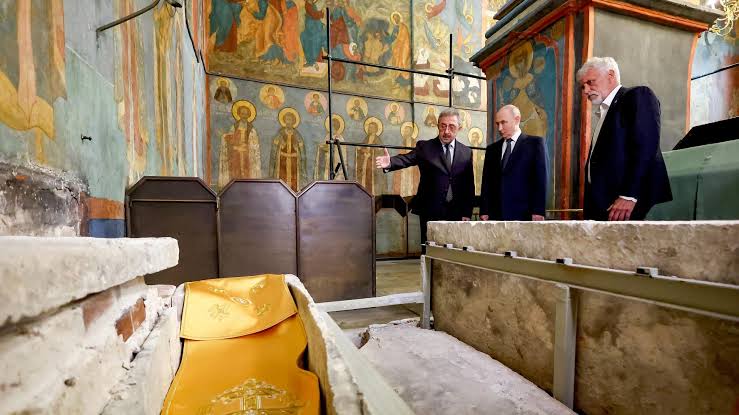
In July 2026, emergency restoration work in the Kremlin’s Archangel Cathedral opened up access to the long-known burial and sarcophagus of Dmitry Donskoy. In August, officials announced that the identity of the remains had been confirmed.
But who was this Dmitry Donskoy, the man we’ve been shown for decades as almost an archangel of the Russian land, the savior from the “Mongol-Tatar yoke”?
The official version is as simple as a school textbook: a young, pious prince led his army onto the Kulikovo Field in 1380 and crushed the “Horde,” setting off the liberation of Rus’. A nice picture for medals and postage stamps.
The reality is a lot less romantic — and a lot more absurd for anyone who likes the grand narrative.
At that point, the Golden Horde had already spent several years tearing itself apart in a civil war known as the “Great Troubles” (1359–1381). Mamai, the man Donskoy supposedly fought, wasn’t even a khan and had no real claim to the throne — he wasn’t a descendant of Genghis Khan, just a warlord who held power through a string of puppet khans. Meanwhile, in the east, the legitimate Genghisid Tokhtamysh was gathering strength to reunite the Horde and topple the pretender.
The Battle of Kulikovo wasn’t a heroic uprising against “the yoke” as such — it was an episode in someone else’s internal Horde crackdown on a rebellious warlord. In this story, Dmitry Donskoy didn’t play the liberator; he was effectively part of a punitive expedition against the rebel Mamai — a useful tool for one part of the Horde against another. A year after Kulikovo, Tokhtamysh crushed Mamai at the Kalka River without any help from Moscow’s army, and shortly after that Mamai was killed in Crimea. Two years later, that same Tokhtamysh burned Moscow to the ground — that’s what “liberation” looked like in practice.
But details don’t matter for a myth. What matters is the relics, the prayer service, the patriarch’s blessing, and the picture for the federal TV channels: here, supposedly, is real, tangible proof of “a thousand years of statehood” and “the struggle against the Horde” — conveniently arriving just when the state once again needs to justify a war with images of a heroic past.
They found the relics, like something out of a fairy tale. Too bad the story built around them is mostly a fairy tale too.