Dmytro Yagunov: Beyond Technological Determinism: Russia’s Adaptive Imperial Flexibility

In this article, we want to challenge traditional academic views on Russian imperialism, emphasising that contemporary analyses fail to take into account the Russian Federation’s adaptive capacity to preserve and project imperial power. Contrary to notions of technological and institutional backwardness, Russia’s neo-imperial apparatus demonstrates extraordinary flexibility through its use of private military companies (PMCs), the instrumentalisation of the criminal population, and systematic reliance on state-sanctioned violence. Drawing on a conceptual model of Russia as a ‘prison state,’ this analysis argues that the Russian imperial system functions as a self-reproducing mechanism in which any liberalisation threatens its fundamental military capacity. The article concludes that comprehensive decolonisation, understood as the dismantling of the current territorial configuration of the Russian Federation, is not only a normative goal but also a strategic necessity for global security.
Introduction
Contemporary scholarship on Russian imperialism suffers from a fundamental analytical deficiency: the persistent application of static models to a clearly dynamic imperial system. Western researchers, relying on assumptions about conservative institutional inertia in empires, systematically underestimate the Russian Federation’s capacity for adaptation and innovation in the projection of power. This misperception has significant political implications, as it obscures the mechanisms by which Russian neo-imperialism regenerates itself in response to geopolitical pressure and technological change.
The prevailing discourse on Russia’s military capabilities exemplifies this analytical gap. While observers correctly identify the Ukrainian Armed Forces’ acquisition of unprecedented operational experience through prolonged defensive operations, they often overlook the parallel—and perhaps more significant—accumulation of combat experience by Russian regular and irregular forces across multiple 21st-century theatres of war. This asymmetry in analytical attention reflects deeper misconceptions about the nature of Russian imperial power and its evolutionary trajectory.
An adaptive imperial apparatus: beyond technological determinism
Characterising Russia as a technologically or institutionally backward country fundamentally distorts the operational logic of the empire. Russian imperial policy demonstrates sophisticated adaptability, particularly in the deployment of asymmetric mechanisms for projecting power. The proliferation and institutionalisation of private military companies within Russia’s strategic architecture is an example of this adaptive capacity. Russian private military companies are not a situational response to specific unforeseen circumstances, but an integral part of a specially designed system of power projection that allows for plausible deniability and minimises the domestic political costs associated with losses in conventional military operations.
This institutional innovation allows the Russian neo-empire to pursue aggressive foreign policy goals while circumventing traditional restrictions on the deployment of military forces. The Wagner Group and the organisations that succeeded it have operated on several continents – from Syria and Libya to the Central African Republic and Mali – promoting Russia’s geopolitical interests through their ability to deny the use of force. This model is not imperial decline, but imperial evolution, an adaptation of 19th-century conquest strategies to the normative and informational conditions of the 21st century.
The prison state as an imperial foundation
The stability of Russian imperial power is based on what might be called the ‘prison state’ paradigm – a system in which systematic violence, torture, and informal prison laws and rules permeates both internal governance and military organisation. This is not merely a rhetorical figure, but an analytical necessity: the Russian state’s ability to project military power stems directly from its willingness and institutional capacity to mobilise a population that is subject to extreme coercion.
The recruitment of military personnel from prisons, widely documented during the ongoing war against Ukraine, illustrates how this mechanism works. By turning prisoners into combatants, the Russian state simultaneously solves the demographic problems of military mobilisation and reinforces the prison logic and culture that underlies its internal order. This practice is not exceptional, but rather symbolic of a broader model in which violence and coercion are not merely instruments of state power, but its fundamental organisational principles.
Importantly, this system demonstrates a path dependency that makes significant liberalisation impossible. The metaphor of a bicycle that needs to keep moving forward to avoid falling accurately reflects Russia’s neo-imperial dilemma. Any significant reduction in the systematic use of violence, any genuine move towards transparency, accountability, or a reduction in rigid vertical governance based on rights threatens to undermine the mechanisms by which the Russian state maintains both internal control and external projection of power. The Russian neo-empire cannot liberalise without ceasing to be a neo-empire.
Implications for the global security architecture
The implications of this analysis extend far beyond regional security concerns in Eastern Europe. Russian Federation’s neo-imperial apparatus, based on systematic violence and demonstrating an ability to adapt in the projection of power, poses a fundamental challenge to the international order. This threat cannot be adequately addressed by mechanisms based on assumptions about Russia’s backwardness or its inevitable decline.
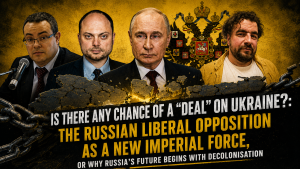
The question facing the international community is not whether to contain Russia’s imperial ambitions, as containment implies stable borders and mutual recognition of spheres of influence. Instead, the strategic imperative is to dismantle the imperial apparatus itself. This inevitably involves supporting decolonisation processes that will lead to the fragmentation of the Russian Federation along lines that correspond to the national and ethnic identities of the formerly occupied populations that have been under Russian imperial rule for five centuries, since the time of the Moscow principality.
This position may seem radical within the framework of traditional political discourse, but it is a logical consequence of recognising the logic of the functioning of a prison state. An imperial system that cannot liberalise without disintegrating and whose military power depends on systematic violence against both its ‘civilian’ subjects and its own citizens mobilised for war cannot be reformed. It can only be transformed through comprehensive decolonisation.
Conclusion
Western scholarship and political discourse must fundamentally re-evaluate prevailing notions of Russian imperialism. The Russian Federation is not a declining state stumbling towards inevitable collapse, but an adaptive empire that has successfully modernised its mechanisms of control and power projection. Its reliance on private military companies, the instrumentalisation of the criminal population, and the systematic use of torture and violence are not archaic relics, but modern innovations in imperial governance.
The path dependency inherent in the prison state model makes significant liberalisation impossible. Therefore, stable security in Europe and beyond requires not containment but decolonisation – the collapse of the imperial structure of the Russian Federation and the restoration of the sovereignty of nations and peoples that have been under imperial rule for over 500 years. Only through such a comprehensive transformation can the cycle of violence originating from Russian imperialism be finally broken.
This conclusion challenges convenient assumptions about gradual reform and integration. However, it reflects the logical consequences of an honest assessment of how Russian imperial power actually functions in the 21st century. The choice facing policymakers is not between idealism and realism, but between a steadfast commitment to decolonisation or an acceptance of the permanent instability generated by an adaptive imperial system that relies on violence, a prison subculture, and governance through informal prison laws and rules.