Dmytro Yagunov: The Berlin Declaration and the Paradox of the ‘Russian Democratic Neo-Empire’

1. Introduction: Identity Crisis and the Search for the ‘Beautiful Russia of the Future’
The signing of the ‘Declaration of Russian Democratic Forces’ in Berlin on 30 April 2023 was a landmark event in the history of modern Russian political emigration. The document, which brought together the signatures of figures such as Mikhail Khodorkovsky, Garry Kasparov, Dmitry Gudkov and representatives of various anti-war initiatives, was intended to consolidate the scattered forces of the opposition around a single strategic platform. The text of the Declaration postulates goals that at first glance seem unconditionally anti-imperialist: an end to aggression against Ukraine, the restoration of the internationally recognised borders of 1991, compensation for victims, and the creation of a constitutional state.
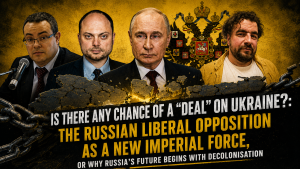
However, despite its clearly anti-Putin rhetoric, the document has been subjected to harsh, systematic criticism from representatives of the national liberation movements of Russia’s indigenous peoples, the Ukrainian intellectual community, and Western researchers of post-colonialism. The essence of the complaints boils down to a paradoxical thesis: by declaring democratic values, the Berlin Declaration actually preserves the imperial structure of the Russian state.

2. Textual and discursive analysis of the Declaration
To understand the imperial underpinnings of the document, it is necessary to analyse not only what it says, but also what the authors chose to leave unsaid. The structure of the Declaration is based on five key points, each of which, when examined closely through the prism of decolonial theory, reveals hidden mechanisms for maintaining imperial control.
2.1. The dichotomy of ‘regime’ versus “state”
The Declaration states: ‘Putin’s regime is illegitimate and criminal. Therefore, it must be eliminated.’ This formulation is the cornerstone of the ideology of the Russian liberal opposition. By localising the source of aggression and pathology exclusively in the ‘regime’ (a temporary political superstructure), the signatories implicitly remove the Russian state itself as a historical and territorial entity from the line of fire.
Critics, relying on the concept of ‘imperial innocence,’ point out that this approach ignores the deeply rooted colonial nature of Russian statehood, which reproduced expansionist practices under tsars, general secretaries, and presidents. By reducing the problem to the personality of the dictator and his entourage, the Declaration proposes a ‘change of management’ in the metropolis, while preserving the very structure of the subordination of the regions to the centre. This avoids the painful conversation about collective responsibility and the need to re-establish statehood on new, contractual terms, or to dismantle it altogether.
2.2. Sacralisation of the 1991 borders as a tool of retention
The clause on the need to restore ‘the internationally recognised borders of Russia’ serves a dual function. In terms of foreign policy, it is an unconditional signal about the return of Crimea and the occupied territories to Ukraine, which is welcomed by the West. However, in the domestic political sphere, this clause serves as a legal barrier to any separatist movements within Russia itself.
Recognising the 1991 borders (the borders of the RSFSR) as ‘sacred’ means automatically denying the right to self-determination to republics such as Ichkeria, Tatarstan, Bashkortostan or Yakutia, if their peoples choose the path of independence. Representatives of national movements point out that the borders of the RSFSR were drawn by the Soviet authorities using administrative and command methods, without taking into account ethnic areas and the will of the peoples, and that their forcible maintenance by democratic methods is no different from imperial policy. Thus, the ‘democratic’ Russia in the version of the Declaration denies colonised peoples the right to secede from the federation in advance.
2.3. The clause on ‘refraining from public conflicts’
Representatives of decolonial movements are particularly alarmed by the signatories’ commitment to ‘refrain from public conflicts in democratic and anti-war movements.’ At a time when there is heated debate within the opposition between supporters of a united Russia (centralists) and supporters of its disintegration (regionalists), this clause is perceived as a tool of censorship.
Any criticism of the imperial consciousness of the Moscow opposition, any reminders of the xenophobic past of individual leaders, can be classified as a ‘public conflict’ and a violation of the Declaration. This creates a mechanism for silencing uncomfortable questions about internal colonisation, allowing the ‘status’ opposition to monopolise the microphone in front of Western partners.
3. Federalism versus Decolonisation: An Ideological Divide
The central point on which the Berlin Declaration is classified by critics as imperial is its commitment to federalism as the only model for the future structure.
3.1. The Myth of ‘True Federalism’
Opposition leaders consistently argue that Russia’s problem is not its size or multi-ethnicity, but the absence of true federalism. According to this logic, restoring budgetary autonomy and free elections to the regions would be enough to eliminate centrifugal tendencies.
The opposition’s policy documents assert that many national republics are economically unsustainable without central support, and that their independence will lead to their degradation and disappearance from the map. This paternalistic position (‘we know better what you need’) is perceived by indigenous peoples as a continuation of colonial rhetoric that denies their capacity for self-organisation and sovereignty.
3.2. The Federation as a prison
However, even Yeltsin’s ‘democratic’ Russia launched a brutal colonial war against Chechnya when it attempted to exercise its right to secession. This proves that changing the label from “authoritarian” to ‘democratic’ does not alter the imperial essence of a state that seeks to hold on to its colonies by force.
Critics point out that the Declaration does not provide for a mechanism for referendums on independence, which means that it imposes on peoples the default status of remaining part of Russia. However, the ‘opposition’ has no moral right to decide the fate of the Bashkirs, Tatars, Yakuts or other peoples.
3.3. Economic colonialism and the resource curse
Criticism from indigenous peoples is also based on economic factors. The regions of Siberia and the Volga (Tatarstan, Bashkortostan, Yakutia, KhMAO) are the main contributors to the federal budget. The idea of ‘preserving a united Russia’ is perceived by their representatives as Moscow’s (including the liberal opposition) desire to maintain control over resource rents. Critics of decolonisation are in fact defending an economic model in which resources are extracted from ethnic republics to ensure the standard of living in the metropolis and to finance state projects.
4. The concept of ‘imperial innocence’ and the rejection of responsibility
An in-depth analysis by sociologists and historians shows that the Berlin Declaration is a product of so-called ‘imperial innocence’.
4.1. Russians as the ‘first victims’
The declaration expresses solidarity with ‘the tens of millions who refuse to participate in the crimes of the regime.’ This narrative constructs an image of the Russian people as hostages, the first victims of Putin’s occupation. This position allows Russians (and the opposition) to avoid responsibility for colonial policy by presenting themselves exclusively as the aggrieved party.
Ukrainian intellectuals and Western researchers point out that this is a form of self-deception. The war in Ukraine is being waged not only by the ‘regime,’ but also by hundreds of thousands of mobilised citizens, supported by millions through taxes and tacit consent, fuelled by a culture that has normalised domination over neighbours for centuries. The Declaration’s refusal to acknowledge this collective responsibility and its limitation of guilt to a narrow circle of ‘war criminals’ is perceived as an attempt to preserve the moral comfort of the imperial nation.
4.2. Cultural superiority and the ‘White Man’s Burden’
The rhetoric of the Declaration’s signatories often reveals a belief that Russia is bringing ‘civilisation’ to the periphery. Navalny and her supporters often appeal to Russia’s ‘European path,’ while ignoring or marginalising Asian and Muslim identities within the country. Representatives of indigenous peoples (Buryats, Kalmyks) see racist undertones in this: ‘Beautiful Russia of the Future’ is being built for white Europeans in Moscow and St. Petersburg, while the cultures of indigenous peoples are seen as archaic, doomed to assimilation or disappearance in the market conditions of a ‘normal country.’
5. The Ukrainian perspective: The threat of revanchism
For Ukraine, the Berlin Declaration poses a threat not because of what it declares, but because of what it preserves. The preservation of a unified, centralised, industrially powerful Russia with nuclear weapons is seen in Kyiv as a war postponed.
5.1. Distrust of ‘Good Russians’
The Ukrainian experience shows that Russian liberals often ‘break down’ on the Ukrainian question (‘Crimea is not a sandwich’). The fact that the Declaration calls for the restoration of borders is perceived positively, but it is not enough. Without the physical disintegration of Russia and its denuclearisation, any democratic regime will inevitably slide back into authoritarianism and revanchism, driven by post-imperial syndrome.
5.2. The problem of reparations and resources
The Declaration refers to ‘payment of compensation.’ However, if Russia remains a single state, the process of paying reparations will depend on Moscow’s political will. In the event of decolonisation, new independent states (such as oil-rich Siberia) could enter into agreements directly with Ukraine and the international community, which would make the process more transparent and secure. Maintaining centralised control over resources through the ‘Federation’ leaves the levers of pressure in Moscow’s hands.