The Preserved Empire: On the Pseudo-Opposition as an Alternative Imperial Project

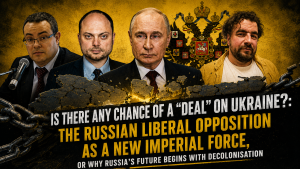
One of the most dangerous illusions held by some of Ukrainians and the international community is the belief in the existence of a ‘good Russia’ that supposedly opposes Putin’s regime and is ready to become a partner in building a just world after its fall, while preserving its colonial essence and imperial orientation.
Mikhail Khodorkovsky, a former oligarch and prisoner of Putin’s system, actively cultivates this illusion, positioning himself as the leader of the Russian opposition and an alternative to the current regime. However, a more detailed analysis of his rhetoric and proposed steps reveals a completely different picture: we are not dealing with the antithesis of imperial policy, but rather a softer version that is more acceptable to Western audiences. This is not the dismantling of Russian colonialism, but its reincarnation under a new guise – an alternative imperial project that aims not to liberate peoples from Moscow’s rule, but to preserve the Empire itself, only with a new face and slightly updated rhetoric.
Khodorkovsky’s recent statement is a vivid illustration of this strategy, which is worth quoting in full:
“The question is not about Putin — he will do everything to stay in power. The question is about us, about each and every one of us. We can continue to pretend that nothing depends on us. But if we remain silent, we become the backdrop for crime. If we get used to it, we become a people who don’t care. I’m not asking you to go out into the square tomorrow. But I am asking you to take at least one step that restores human dignity. And here is what everyone can do right now, depending on the risk they are willing to take. Stop repeating lies. Even for the sake of peace. You don’t have to argue with everyone — just don’t repeat propaganda. Support those who are saving and treating people. These are volunteers, funds to help the wounded and refugees, and humanitarian projects. It doesn’t matter where you are: in Russia or abroad — you’re not helping the Armed Forces of Ukraine. Talk to your loved ones. One-on-one. Don’t tell them, ‘You’re a Vatnik’ or ‘You’re a Traitor.’ Say, ‘I’m hurting,’ ‘I’m scared,’ ‘I’m ashamed.’ Let’s just try to understand — why is this happening? A quiet conversation is sometimes stronger than a shout. Make a choice at work. If you make drones, shells, rockets — I know that there isn’t always a good choice. But there is almost always some choice: to leave, to switch, to sabotage, to stall for time. I’m not romanticising, I understand the price. But there comes a point when the words ‘I’m just doing my job’ turn into ‘I’m participating.’ The main question is not what the authorities are doing, but what we are doing to remain human.
This is the crux of the problem. Khodorkovsky offers Russians moral comfort: it is possible to oppose the war without helping its victims defeat the aggressor. It is possible to have a clear conscience by supporting ‘humanitarian projects’ for the very Russian soldiers who kill, rape and torture Ukrainians and even Russians themselves. This is not a call for real resistance, but a proposal for a surrogate — an imitation of a moral choice that allows both the Empire itself and its population to remain in a zone of psychological comfort. After all, real resistance to genocide means supporting those who are defending themselves against genocide. Real resistance means recognising Ukraine’s right to victory and actively helping in that victory. Instead, Khodorkovsky suggests that Russians stay ‘above the fray,’ keeping their moral distance from both Putin and his victims.
The call ‘not to go out to protest’ but simply to talk quietly with your neighbour in the kitchen, is a classic strategy for preserving the status quo under the guise of gradual change. Khodorkovsky contrasts the authorities with ‘the people,’ as if these authorities had fallen from Mars rather than being the flesh and blood of these very people, raised on imperial attitudes and colonial policies over the last five hundred years. The Moscow Empire is not an anomaly in Russian history, not a disease that has afflicted a healthy body. It is the very essence of Russian statehood, from Ivan the Terrible through Peter I and Catherine II to Stalin and Putin. It is a continuous tradition of expansion, absorption of neighbouring peoples, destruction of their cultures and languages, turning them into ‘ethnographic material’ for the construction of a ‘great power.’ And it is on this tradition that generations of Russians have been raised, it is these values that have been transmitted through education, culture and literature.
When Mikhail Khodorkovsky suggests ‘even if you produce drones, rockets, shells’, he means not to damage the microchips drastically, but to produce only 99 drones per month instead of 100. If you used to make 100 shells a month, now make 98, and consider yourself a fighter against the regime.
Mikhail Khodorkovsky is actually calling for a symbolic gesture that will not change reality, but will allow a person to sleep peacefully. This is a morality for home use, which does not involve real sacrifices, real risks, or real choices. Real resistance would mean refusing to participate in the production of weapons at all, switching to the side of those who are defending themselves, and publicly condemning the aggression. Instead, Russians are offered the convenient role of ‘deeply hidden and generally invisible internal dissidents’ who can remain part of the system, continue to feed the military machine, but at the same time consider themselves ‘good Russians’ who ‘disagree with Putin.’
The most telling recommendation is to support ‘volunteers, funds to help the wounded, refugees, humanitarian projects’ with the obligatory caveat ‘you are not helping the Armed Forces of Ukraine.’
What does this mean in practice? It means helping the very Russian military personnel who came to kill Ukrainians. It means supporting a system that allows Putin’s regime to shift part of its social burden onto ‘good Russians’ and international organisations. It means preserving the Empire’s resources — so that wounded soldiers can return to continue killing, so that refugees from the occupied territories do not become a burden on the regime, but can be used in propaganda campaigns about ‘protecting the Russian-speaking population.’ At the same time, a categorical ban on helping the Armed Forces of Ukraine means refusing to support those who are actually defending civilised values from barbarism, who are fighting for the right of peoples to self-determination, who stand between Europe and a new wave of Russian expansion.
This position is not a personal eccentricity or the result of a misunderstanding. It is a systematic, ideologically based strategy to preserve the Russian empire under new packaging. After all, what is ‘good Russia’ in the minds of Russian ‘oppositionists’? It is a Russia without Putin, but with the same territory, with the same control over Chechnya, Tatarstan, Bashkortostan, Yakutia and dozens of other subjugated peoples. It is a Russia with softer rhetoric, but with the same vision of itself as a ‘great power’ with a ‘special mission’ in the world. This is a Russia that may end the war in Ukraine (after retaining part of the captured territories through a ‘compromise peace’), but will retain its imperial thinking, its claims to a ‘sphere of influence,’ and its right to determine the fate of neighbouring countries.
Khodorkovsky and his like-minded colleagues offer the world a convenient illusion: that it is possible to establish relations with Russia simply by replacing Putin with a ‘more liberal’ leader. As if the problem lies in the personality, not the system. As if the empire can be reformed from within without dismantling its colonial structure, without recognising the right of enslaved peoples to independence, without going through the process of decolonisation and decommunisation. This strategy is particularly dangerous because it appeals to the West’s fatigue with conflict, its desire for a quick ‘solution to the problem,’ and its hope that it is possible to return to ‘normality’ without radical changes in Russia.
History knows many examples of such ‘alternative imperial projects.’ All these examples demonstrate one pattern: an empire can change its ideological shell, modernise its rhetoric, adapt to new circumstances, but it retains its colonial essence until true decolonisation takes place – territorial, political, cultural and psychological.
A real alternative to Putin’s regime cannot be another version of the Empire. It must involve dismantling the colonial system, recognising the right of all oppressed peoples to self-determination, full compensation for victims of Russian aggression, vetting and prosecution of war criminals, and a profound cultural transformation of Russian society through a process of decommunisation and decolonisation. This means that ‘Russia after Putin’ cannot remain within the same borders, cannot retain the same status, cannot continue to claim the role of a ‘great power.’ It must be a fundamentally different political entity with the Russian Empire breaking up into separate nation states.
‘Moderate opposition members’ offer a completely different perspective – preserving the Empire under new leadership. That is why their appeals are so cautious, so vague, so focused on preserving the psychological comfort of Russians. That is why they so remain persistently silent on the topic of decolonisation, on recognising Ukraine’s right to complete victory, on supporting the liberation of Ichkeria, Tatarstan and other colonised territories. Their project is one of preserving the Empire, keeping it in a state of suspended animation until better times, when it will be possible to return to ‘normality’ without fundamental changes in the structure of Russian statehood and the consciousness of Russian society. And that is why this project is no less dangerous than Putin’s, because it offers the world the illusion of peace without justice, stability without decolonisation, a future without rethinking the past.