Institutional Loyalty and Identity Dependence: the Phenomenon of ‘Liberal Imperialism’ in Post-Soviet Religious Discourse

Compulsory self-identification as a ‘foreign agent’ — a legal mechanism introduced in the Russian Federation and extended to private individuals between 2017 and 2022 — is not merely an administrative restriction, but an instrument of discursive control operating on the principle of internalised surveillance. An individual obliged to affix a stigmatising label to every text they publish becomes an agent of their own humiliation, regardless of their geographical location. This phenomenon is best illuminated through Foucault’s conceptual framework: panoptic logic here reaches its logical culmination — the external overseer is rendered superfluous, as the subject performs that function themselves.
A telling illustration of this configuration is the public activity of Andrei Kuraev — a former protodeacon of the Russian Orthodox Church and now a prominent critic of both the ROC and the Putin regime. Despite his outward opposition, his theological and ecclesiological arguments reproduce the foundational categories of Moscow Orthodox imperialism, particularly regarding the legitimacy of national Orthodox churches. His characterisation of the ecclesiological formula of the Orthodox Church of Ukraine — ‘A Church of the people, for the people’ — as ‘heresy’ and ‘paganism’ is symptomatic: it reveals an inability to conceive of the Church outside the paradigm of state-centred sacredness, in which the people are the object of pastoral care but never the subject of ecclesial existence.
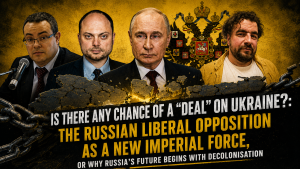
This observation speaks to the broader problem of what might be termed ‘structural liberal imperialism’ in the post-Soviet context: an intellectual stance in which criticism of an authoritarian regime coexists with the preservation of the deep cognitive frameworks that the regime generated and reproduced — notions of the indivisibility of Russian Orthodoxy and statehood, the centrality of Moscow in the Orthodox world, and the inauthenticity of any peripheral identity. The documented collaboration between the hierarchy of the Russian Orthodox Church and the Soviet security services — confirmed by declassified archival materials — is not an anomaly but a structural expression of this symbiotic model.
Physical emigration and even a formal rupture with the institution are therefore not sufficient conditions for the decolonisation of the discursive horizon. Categories of thought formed under a specific theological-political order exhibit far greater inertia than institutional loyalty per se. The phenomenon warrants sustained investigation within the framework of postcolonial religious studies — particularly with respect to the mechanisms by which imperial cognitive structures are reproduced among those who self-identify as opponents of the very system that produced them.