Dmytro Yagunov: The Strategic Instrumentalisation of “Traditional Values” in Russian Colonialism

The most dangerous analytical error regarding Russian aggression against Ukraine is the assumption that it has a purely rational explanation lying in the struggle for territory, resources, or geopolitical influence. Although the aggression is indeed accompanied by territorial invasion of Ukraine, colonial advancement in Africa, and a permanent military presence in Europe in the form of sabotage and intelligence activity, its underlying nature is at once more complex and simpler. This is a war waged in order to flee the mirror – to escape the necessity of assessing one’s own life and one’s own state objectively.
It is precisely here that “traditional values” reveal themselves not as a substantive ethical programme but as a function. The Russian state has turned into a total coercive-corrupt vertical, in which every level of power is a mechanism for extracting rent and governance is conducted according to the logic of a “carceral”, prison-like state. Under such conditions, society needs a powerful, fast-acting “narcotic” capable of dulling the pain of awareness – and that narcotic became aggressive war, ideologically wrapped in the rhetoric of values.
A specific symbiosis has taken shape between the regime, the elites, and the population. The regime and the elites lead a crowd cemented together by “traditional values” and by a false memory of the “grandfathers” who “defended an ungrateful Europe from fascism”. Yet the crowd, too, clings desperately to the regime, because without it people would have to look the truth in the eye. Every missile fired at a peaceful city, every occupied territory, every lying piece of news is not merely a crime or a piece of propaganda but also a defence mechanism against the recognition of one’s own and the nation’s emptiness.
By this logic, “traditional values” perform a compensatory role: the formula ‘we are a great power’ compensates for ‘I am worthless’, ‘we have nuclear weapons’ substitutes for ‘I have no future’, ‘we will defeat everyone’ drowns out ‘I have lost my life’. This is not patriotism but a collective neurosis, in which aggression directed outward is a way of not looking inward. Value rhetoric is therefore not an end but an instrument – an instrument of anaesthesia that renders the illusion vitally necessary.
The instrumental nature of this anaesthesia intensifies over time, for the price of acknowledging the truth rises with every day of the war. At an early stage the formula ‘we were deceived’ was still possible; later, ‘we made a mistake’; later still, ‘it was a catastrophe of which we knew nothing’. Yet every new crime, every destroyed city, and every new grave makes acknowledgement ever more unbearable: to admit the truth means to accept that support for the regime was complicity, and that one’s own silence was a form of sanctioning violence. Thus arises a psychologically insurmountable wall: the longer and bloodier the war becomes, the stronger grows the need to deny its nature – and the more effective becomes the anaesthetising function of value rhetoric.
This mechanism rests also on an entirely material substrate – the profound informational and experiential isolation of the overwhelming majority of the population, a large part of which has never crossed the state border, while the foreign experience of those who have was not infrequently confined to a narrow range of resort destinations. Under such conditions, censored “news” functions not so much as a source of information as a defence mechanism against any collision with reality, both within the country and beyond it. Resistance to this logic remains the lot of the few, for whom acknowledging the truth means a conscious refusal of complicity; for the absolute majority, the illusion remains not a matter of choice but a condition of psychological survival.
THE GENESIS OF THE “RUSSIAN WORLD” DOCTRINE: FROM A NETWORK PROJECT TO AN INSTRUMENT OF AGGRESSION
It is worth recalling that the concept of the “Russian World” originated in the 1990s within the milieu of the so-called “Moscow Methodological Circle”. In the late 1990s, Russian political strategists constructed the concept as one of the responses to the disintegration of the post-Soviet space and Russia’s loss of its dominant positions. Initially it had a cultural-linguistic character: the “Russian World” was defined as a network structure of communities that think and speak in Russian. Yet this very formula already contained the idea of a supra-territorial identity capable of competing with the sovereignty of the newly emerged states.
At the heart of the concept lay the idea of protecting “compatriots” – a symbolic, legally undefined category that the Kremlin could expand at will depending on political expediency. Particular significance was attached to Russian minorities in the “near abroad”: Ukraine, Moldova, the Baltic states, as well as to territories with a contested status – Crimea, the Donbas, Transnistria. The vagueness of the notion of “compatriots” turned it into a universal pretext for intervention.
In the 2000s the construct was institutionalised. In 2007 a decree of the President of the Russian Federation established the “Russian World” foundation; a series of de’4 radically restructured it, strengthening its subordination to the state, with the Ministry of Foreign Affairs of the Russian Federation in effect becoming its founder. Under the cover of cultural and educational activity, the foundation pursues a neo-imperial agenda: the creation of a transnational network of influence, the mobilisation of diasporas, the undermining of the linguistic and cultural sovereignty of other states, and the legitimation of aggression. The Russian Orthodox Church lent the concept its religious dimension: through an appeal to “Holy Rus” and the image of Moscow as the “Third Rome”, it presents the Kremlin’s political aims as the fulfilment of a sacred mission.
The turning point was the Russo-Georgian War of 2008, when the rhetoric of protecting ‘compatriots’ for the first time justified direct military aggression and created the model of “frozen conflicts”. In 2014 and 2022 the “Russian World” doctrine directly served the annexation of Crimea, the war in the Donbas, and the full-scale invasion. Thus, over three decades, an abstract intellectual idea evolved into an instrument of expansion, demonstrating how cultural and value-based narratives are turned into a justification for war crimes. Unlike the classical colonialism of the nineteenth century, the “Russian World” seeks not so much formal annexation as zones of influence in which Moscow retains de facto control while another state’s sovereignty is formally preserved.
SACRED SACRIFICE AND THE CULT OF VICTORY: ‘TRADITIONAL VALUES’ AS A MECHANISM OF MOBILISATION
The instrumental nature of value rhetoric becomes especially evident in an analysis of how the Russian state has for centuries used war to maintain the unity of the empire. The existence of a state built on the colonial subjugation of dozens of peoples required the continuous heroisation and sacralisation of power. The classic mechanism became the “injection of sacred sacrifice”: the cultivated conviction that “our people” made an immeasurable sacrifice for the sake of victory over an external enemy, and that this sacrifice sanctifies the authorities, the state, and all subsequent generations.
The first such cycle was built around the cult of victory over Napoleon. The year 1912 is telling, when the tsarist secret police searched throughout the empire for elderly witnesses of the Napoleonic invasion; living human memory might become the body of the official narrative. At the same time it was precisely then that the internal contradiction of the instrument revealed itself: on the eve of the formation of the Entente, the anti-French cult became diplomatically inconvenient, and Russia was forced to seek, as a matter of urgency, a replacement for an instrument that had served it for a hundred years. The First World War destroyed both the dynasty and the very apparatus of sacralisation.
The second cycle formed around the “Great Patriotic War”. The semantics themselves are fundamental: not the “Second World War” but precisely the “Patriotic” war – the defence of the native land, which inscribed the new conflict into the ready-made cultural matrix of 1812. The real sacrifices of millions of people became the foundation of a new sacred narrative invoked by any regime in need of legitimacy – from the suppression of the Hungarian uprising of 1956 to the annexation of Crimea. The logic is simple and terrible: “our grandfathers defeated fascism, therefore what we are doing today is also a struggle against fascism”.
The beginning of the full-scale invasion of Ukraine in 2022, according to the concept proposed here, signifies the launch of a third hundred-year cycle of sacralisation. At the parades, alongside the ever-fewer veterans of the Second World War, there appear veterans of the “special military operation”; the state methodically carries out a symbolic transfer, filling the ideological vacuum with new “heroes”. This gives rise to a particular threat: veterans’ “communities”, patriotic and “Cossack” formations receive a state-sanctified right to violence – structurally similar to the way the combat detachments of the totalitarian states of interwar Europe grew out of postwar veterans’ associations. The instrument of sacralisation has already been launched, and it will not disappear with a change of personalities in the Kremlin, because ideological constructs nourished by blood and suffering are extraordinarily tenacious.
THE “RUSSIAN BIRCH”: NATURAL SYMBOLISM IN THE SERVICE OF IMPERIAL INVERSION
The instrumental use of culture is not exhausted by grand ideological constructs such as the “Russian World” or the cult of victory – it penetrates even the most everyday and, at first glance, apolitical symbols. A telling example is the birch, which occupies a special place in the Russian symbolic space and functions not only as a national image but as a finely tuned instrument of propaganda. Unlike most national symbols, which emphasise strength or grandeur, in the Russian cultural code the birch is systematically associated with sacrifice, mourning, and passive suffering – and it is precisely this that turns it into a mechanism for legitimising colonial policy through an inversion of the roles of aggressor and victim.
The central element of this strategy is the consistent identification of the birch with maternal grief rather than with a heroic military tradition. Memorials on the occupied territories systematically include the birch as an obligatory element, and Russian soldiers are depicted not as aggressors but as “children” whom the homeland has “lost”. When society is invited to mourn losses rather than to celebrate victories, any criticism of military policy becomes taboo – it is construed as “disrespect for the memory of the fallen”. The birch is consistently gendered as a “female tree”, associated with passivity, defencelessness, and vulnerability; the combination of a national symbol with such characteristics creates a paradox in which an aggressor nation represents itself through a symbol of defencelessness and appears not as a predator but as a ‘vulnerable victim’ that is ‘forced to defend itself’.
A biological feature of the birch – its capacity to grow in different climatic zones – is exploited for the symbolic camouflaging of imperial expansion. The planting of birches beside military memorials on the occupied territories, from Kaliningrad to the Kuril Islands and from Transnistria to Syria, creates the illusion of the “naturalness” of the Russian presence, while the memorials to the “fallen” themselves perform the classic colonial function of symbolic markers that designate a territory as “Russian”. Especially cynical is the practice of planting birches beside memorials at the sites of mass crimes of the Soviet regime: the visual code of “shared sacrifice” equates the victims of the Holodomor with the “fallen” occupiers, and the victims of deportations with the aggressors, instilling in younger generations the false thesis that “everyone suffered equally” and that there is supposedly no difference between executioner and victim. Thus, a seemingly apolitical tree performs entirely strategic work – the symbolic inversion of aggressor into victim, gender manipulation through feminisation, the naturalisation of occupation, the export of victimhood, and the sacralisation of aggression.
THE “SOCIETY OF SIEGE”: THE CARCERAL STATE AND THE PERMANENT ENEMY
The structural foundation of the instrumentalisation of values is revealed by the author’s concept of the carceral state. The carceral state is not merely an aggregate of repressive institutions directed inward at society, but a particular form of organisation in which discipline, coercion, and fear are the fundamental mechanisms for reproducing the legitimacy of power. Applied to Russia, this framework lays bare the regime’s deep structural dependence on a permanent enemy – real or constructed, internal or external.
For the Russian Empire – in any institutional form, whether the tsarist autocracy, the Soviet Union, or the Russian Federation – war was not an anomaly but a systemic factor of internal stability. The doctrine of a “siege society” requires permanent mobilisation, which renders social reflection on one’s own situation impossible. In this, war performs at least three functions: it delegitimises the opposition by stigmatising criticism as “treason”; it redistributes public attention away from the structural failures of an economy under conditions of stagnating real incomes; and it generates new corporate interests – the military-industrial complex, the military-administrative nomenklatura, “volunteer” structures – that constitute an organic part of the carceral economy.
From this follows the structural impossibility of “peace without collapse”: a hypothetical cessation of hostilities would confront the regime with demobilised fighters accustomed to status and payments, a degraded civilian economy, and inflated expectations of the “fruits of victory”. The military imperative is therefore not the tactical choice of a particular leader but a systemic attribute of a carceral state incapable of reproducing itself under conditions of normality. “Traditional values” in this model are the language in which the siege describes itself as the norm.
A methodological caveat is of fundamental importance. Any analysis that reduces Russia to the formula of “a dictator and his victims” reproduces an intellectual error that allows the question of social agency to be evaded. To grant Russian society the status of a collective victim is not only analytically mistaken but also practically harmful: it removes moral and legal responsibility for colonial aggression. The carceral state reproduces itself through the consensus of its subjects no less than through coercion exercised upon them; the military imperative is the systemic product of a five-hundred-year tradition, in the reproduction of which a significant part of society actively participates.
This social complicity has a concrete psycho-cultural mechanism that may be designated as internalised carceral thinking. Whereas classical criminology regards carceral practices as external coercion exercised upon the individual, in the case of Russia what is at issue is the assimilation of carceral logic at the level of mass consciousness. For centuries prison and camp culture – from the Siberian penal servitude to the Gulag – not only defined state practices but also permeated everyday consciousness, forming durable codes of masculinity, submission, violence, and loyalty. This is why the regime’s escalatory trajectory – from the Chechen campaigns of 1999, through the armed intervention in Georgia in 2008 and the annexation of Crimea in 2014, to the full-scale invasion of 2022 – is perceived within society not as a series of anomalies but as a reproduction of the customary order of things. “Traditional values” in this sense are rather a superficial, “respectable” name for a deep carceral matrix reproduced from generation to generation.
THE CRIMINAL-PRISON MATRIX OF POWER: ‘FENYA’, ‘PONIATIYA’, AND THE CARCERAL LANGUAGE OF DOMINATION
Carceral logic reproduces itself not only through institutions of coercion but also through entirely concrete and readily recognisable mechanisms – above all through the very language of power and the unwritten rules inherited from the criminal-prison milieu. The model of the prison-carceral state describes a system of governance in which this logic – informal prison hierarchies, control through violence, and the instrumental use of the criminal milieu – extends far beyond penitentiary institutions and structures the entire state apparatus: from military units to regional administrations. This is not a matter of the “capture of the state” by organised crime, but of the deliberate construction of a state that functions according to informal prison laws at every level.
A key role here is played by what may be called institutional borrowing. Behind the formal façade of constitutional guarantees, the separation of powers, and judicial protection, real governance is carried out through personalised, opaque networks and unwritten rules – the “Sistema”, structurally equivalent to the prison “poniatiya”. Empirical data show that Russian police and penitentiary-service officers overwhelmingly perceive informal prison laws as “necessary and useful” for the performance of their official duties, in effect legitimising the criminal ethos as an instrument of state function. The structural kinship between the “poniatiya” and the principle of elite governance is not a metaphor but a working mechanism for the reproduction of opaque power and the seizure of resources.
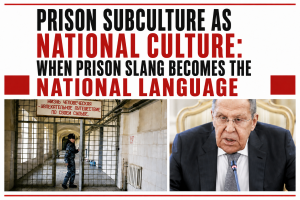
The most vivid manifestation of this is the demonstrative use by the political leadership of prison jargon (‘fenya’) and prison logic in official discourse. These are not chance slips of the tongue but a deliberate strategy that resonates deeply with a mass consciousness long prepared by the romanticisation of the criminal world – from the ‘blatnaya’ stage song to the everyday use of prison slang. By resorting to the coarse language of the criminal-prison milieu, the state normalises coercion, violence, domination, and unaccountability, representing politics as an exercise in “naked” force, in which weakness is despised and submission is taken for granted. Opponents – internal and external – are implicitly categorised within the logic of the prison hierarchy, and the state itself appears metaphorically as a prison in which all citizens are inmates. The state’s adoption of the logic of the “poniatiya” is at the same time a demonstrative rejection of Western liberalism and transparency: the criminal “truth”, utterly anti-statist in origin, is transformed into an anti-liberal political doctrine that justifies arbitrary power through a cult of force.
This same logic is laid bare by the new report of the European Committee for the Prevention of Torture (CPT), adopted in April 2025 and devoted to prison subculture in post-Soviet prisons. Despite Russia’s withdrawal from the Council of Europe and its denunciation of the relevant convention, the document’s principal thesis remains valid: Russian prisons – like the penitentiary institutions of many other post-Soviet states – are still governed by a set of informal prison rules. The CPT substantiates the concept of “carceral collectivism” (as opposed to the “carceral individualism” typical of most Western European countries), which rests on three components: management through the mutual surveillance of the inmates themselves, the delegation of power and control to the inmates themselves, and collective accommodation in shared barracks. Governing an enormous prison population proved impossible by any means other than transferring part of the supervisory powers to the inmates themselves – and this carceral model, assimilated at the level of mass consciousness, remains in force even after Russia’s formal rupture with European institutions, which makes plain the limits of any purely institutional reform.
THE INSTITUTIONAL HEREDITY OF VIOLENCE: THE LIMITS OF VALUE RHETORIC
Russia’s declared monopoly on “traditional values” is definitively refuted by an analysis of the institutional heredity of violence – above all sexual violence. In 2026 Russia’s armed and security structures were, for the first time, included in the annex to the annual report of the UN Secretary-General on conflict-related sexual violence, for the systematic use of such practices against prisoners of war and detained civilians. Moscow’s reaction was telling. Instead of denying specific facts, Moscow responded with a mirror-image counter-accusation. Such a reaction is a marker that violence is not perceived as something requiring denial on the merits, because it is part of the normative background noise of the system.
To understand why this is a continuum rather than an anomaly, it is worth turning to literature as a primary source. In his study “Sakhalin Island” (1895), Anton Chekhov records a system in which female convicts were distributed among settlers as property, and forced cohabitation was formalised through the bureaucratic euphemism of “joint household establishment”. Violence here is not denied – it is written into the price of the bargain and fixed by departmental orders and articles of the statute. More than half a century later, Aleksandr Solzhenitsyn, in “The Gulag Archipelago”, documents the same system in its Soviet version: the ritual of the initial “distribution” of women remained unchanged, and survival was exchanged for the body. The Soviet state inherited from the tsarist one not isolated practices but an entire institutional code.
Between Chekhov, Solzhenitsyn, and the UN report there extends a single, prolonged phenomenon with concrete mechanisms of reproduction. Among them: (1) institutional legitimisation – the normalisation of violence through a bureaucratic language that replaces “rape” with “corrective measure” or “joint household”; (2) the absence of accountability as a systemic feature – impunity is not a malfunction but an element that ensures the reproduction of the practice; (3) social normalisation and tacit complicity – a practice that need be neither explained nor defended, because it is perceived as the natural order of things.
It is precisely the third mechanism that explains why the contemporary official reaction is a deflection of attention rather than a denial: at the deep cultural level there is nothing to hide from oneself. Any study of Russia’s sexual and other crimes must therefore regard them not as a sum of isolated acts but as a manifestation of a deeply rooted civilisational matrix formed over the last five hundred years. Ignoring this context turns every report into a description of symptoms without a diagnosis – and it is precisely against this background that the rhetoric of “protecting traditional values” exposes its instrumental rather than substantive nature.
CONCLUSIONS
The analysis conducted allows a summarising thesis to be formulated: in the Russian colonial project, “traditional values” are not normative substance but a strategic instrument. They perform at least four interconnected functions – psychological anaesthesia for a society incapable of rational self-assessment; the legitimation of neo-imperial expansion under the guise of protecting ‘compatriots’ and a ‘shared faith’; mobilisation through the sacralisation of sacrifice and the cult of victory; and, finally, the normalisation of violence rooted in the institutional code of the carceral state.
From this follows the principal practical conclusion. This war cannot be ended through the military defeat of the regime alone, since it is not only a “Kremlin project” but also a psychological support for millions and a product of a five-hundred-year tradition. Unlike the postwar denazification of Germany, which took place under external compulsion and with the participation of the Allies, no analogous external force will stand over Russia even under an optimistic scenario. Ukraine and Europe must therefore think not only in terms of the current settlement but also in terms of a strategic architecture of security and deterrence for decades ahead – one effective with respect to both the present regime and its successors. The illusion that ‘after a change of power everything will change’ is a dangerous one: the deep structure of social consciousness, formed by blood and suffering, is reproduced across generations, and it is precisely in this that the principal challenge of the present moment consists.