“The People’s War” and Its Lessons: General Ludendorff’s Truth, Which the Political Elite Doesn’t Want to Hear

Erich Ludendorff is one of the most controversial figures of the First World War. The effective commander of the German war machine in its final phase, the architect of operations on the Eastern and Western Fronts, a man who held the fates of millions in his hands. His memoirs My War Memories 1914–1918 are not merely a military-technical report. They are a painful, at times merciless reflection by a man who watched as state and society were torn apart between the front and the rear, between sacrifice and profiteering, between heroism and petty self-interest. More than a hundred years have passed. You read it — and feel an uncomfortable sense of recognition.
“A WAR OF PEOPLES IN THE LITERAL SENSE”: ON TOTAL MOBILISATION
Ludendorff formulates the central thesis of his military philosophy with extraordinary precision:
“In this war it was no longer possible to distinguish where the power of the army and navy ended and the power of the people began. The armed forces and the people formed a single whole. The world witnessed a war of peoples in the literal sense of the word. The mightiest states on our planet stood against one another with this combined strength. To the struggle against the enemy’s armed forces on vast fronts and distant seas was added the struggle against the psychology and vital forces of enemy peoples, with the aim of destroying and exhausting them.”
This is the concept of total war — long before Ludendorff himself would write his book of that name in 1935. Already in his memoirs he records: modern war (as it then stood) knows no boundary between the “front” and the “rear” as separate worlds. It is a single organism. And the winner is the one who can fully mobilise that organism — not only in terms of bayonets and guns, but psychologically, economically, and morally.
Significantly, he also speaks of another dimension: the struggle against the psychology of enemy peoples. Information warfare, psychological warfare — these are not inventions of the twenty-first century. Already in 1914–1918, the great powers deliberately undermined one another’s morale. Those who understood this better and applied it more systematically gained the strategic advantage.
“TO GATHER ALL FORCES TO THE LAST MAN”: ON THE JUSTICE OF MOBILISATION
The next passage concerns the principle of total and equitable mobilisation of resources:
“The war imposed on us the duty of gathering and deploying all forces to the last man. Whether they were thrown into battle, sent to work in the rear, needed for the war industries or for some other work in reserve units or in the state — this did not matter. Of course, a person could serve the homeland only in one place, but it was necessary to make purposeful use of their strength.”
Here Ludendorff speaks not of compulsion but of the rational distribution of human resources under conditions of total threat. The state must know where, by whom, and how to deploy each person — at the front, in production, in logistics, in administration. The key word is purposeful — without waste, without privilege, without any possibility of “dropping out” of the system for those with connections.
This was the ideal. Reality proved painfully different.
“SOMETHING EXTRAORDINARILY UNHEALTHY”: ON THE CHASM BETWEEN FRONT AND REAR
And here is the sharpest passage in the memoirs. Ludendorff describes what was destroying the army’s moral backbone from within:
“Units returning from the front after heavy fighting encountered there auxiliary-service conscripts and women who, living under peacetime conditions, were earning many times more than the soldiers. This greatly distressed men who daily risked their lives and endured extreme privation, and it further intensified general dissatisfaction with pay conditions. The use of auxiliary-service conscripts in the rear areas, given their high wages, was becoming a double-edged weapon. There was something extraordinarily unhealthy in these conditions.”
“Something extraordinarily unhealthy” — this phrase deserves separate attention. Ludendorff is no revolutionary, no socialist, no demagogue. He is a conservative Prussian general, a man of the system. And even he cannot avoid calling things by their proper names: when a soldier who risks his life in the trenches every day comes back and sees that those who have “dodged” to the rear are living better and earning more — that is a systemic injustice which undermines combat effectiveness.
Not enemy propaganda. Not “betrayal” in the conspiratorial sense. But plain, visible, glaring inequality between those who pay the price in blood and those who pay the price of… inconvenience.
“EGOTISTICAL CURRENTS” AND FORGOTTEN GRATITUDE: ON THE MORAL DEGRADATION OF THE REAR
And finally — the most personal, most bitter passage in the memoirs:
“The soldier was particularly troubled by his future after the war. In view of the new economic phenomena, and also the increasingly acute egotistical tendencies in economic matters, and considering the merciless lust for gain that had taken hold at home, this was entirely natural. Even when I was Chief of Staff of the Commander-in-Chief in the East and relations at home had not yet become so strained, I tried, through notices in army newspapers, to explain to soldiers what the homeland was doing for war invalids and for the widows and orphans of soldiers. I devoted much attention to these questions, and watched with sorrow as those who had remained at home gradually lost their sense of gratitude towards those who had suffered in the war, and as the spiritual experiences of the latter were frequently not treated with due respect. This was a matter for the whole German people; its exploitation for party-political purposes was impermissible.”
What is truly striking here is this: Ludendorff — both as Chief of Staff and as a memoirist — tries to explain to soldiers that the rear is thinking of them, that the state is caring for invalids, widows, and orphans. He writes notices for army newspapers. That is, he has to do this — because without such reassurances soldiers no longer believe it themselves. The bond between front and rear has ruptured so completely that special propaganda is required simply to maintain the elementary feeling: “you are remembered, you have not been abandoned.”
And the most important detail: Ludendorff records how the sense of gratitude gradually faded. The rear began to take soldiers for granted — or ceased to think of them at all, absorbed in its own economic troubles and “lust for gain.”
ONE HUNDRED YEARS LATER: A MIRROR FOR UKRAINE’S ELITES
Everything cited above describes Germany in 1914–1918. But reading Ludendorff today, one cannot avoid drawing the parallel. And the parallel is not a rhetorical flourish — it is because the mechanism by which the social contract of the rear disintegrates during total war is structurally identical across every era.
What do we observe in Ukraine since February 2022?
First: the justice of mobilisation. Ludendorff said — deploy each person purposefully: some at the front, some in production, some in administration. In Ukraine this system operates unevenly. Those with resources or connections find ways to avoid the front or secure a safe “deferment.” Those without go to the frontline again and again, without rotation, without proper rest. The chasm between those who “pay the price” and those who “win at the rear” is visible and painful.
Second: economic inequality and “lust for gain.” Ludendorff wrote of the “merciless lust for gain that had taken hold at home.” In Ukraine — luxury cars in central Kyiv, restaurants, nightclubs, advertising boards for premium goods — and simultaneously soldiers who crowdfund money for drones through volunteers. This is not merely social inequality. It is a symbolic affront that destroys motivation.
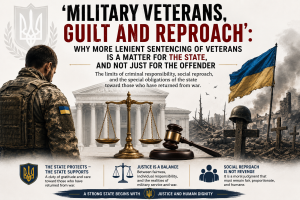
Third: the future of veterans. Ludendorff had to write notices in army newspapers to convince soldiers that they were remembered. Ukraine today already has over a million veterans and potential veterans. Systems of reintegration, psychological support, and economic adaptation are in an embryonic state. Businesses do not want “a veteran with PTSD.” The state cannot keep pace. Society is in survival mode. And the veteran asks himself: what was it all for?
Fourth, and most importantly: the behaviour of the political elites. Ludendorff wrote with indignation that the question of gratitude to veterans “was being exploited for party-political purposes.” He regarded this as impermissible. In Ukraine we observe something worse: the questions of mobilisation, rotation, social guarantees for service personnel, and the future of veterans find no systemic solution at all — because they are inconvenient. They demand political will, a genuine redistribution of burdens, a curtailment of privilege. And Ukrainian elites — in the overwhelming majority — are not prepared for that.
Not because they are “bad people.” But because this is a structural problem of elites formed in the logic of rent-seeking access to resources, not in the logic of public accountability. War demands a different logic. And the transition is painful.
WHAT GERMANY FAILED TO LEARN FROM ITSELF — AND WHAT UKRAINE MUST LEARN
Ludendorff described the symptoms. But Germany did not cure the disease. The consequences were November 1918, the “stab-in-the-back” myth (which Ludendorff himself would later formulate), the Weimar Republic, instability — and ultimately 1933.
The price of ignoring the real problems between front and rear proved catastrophic — not only in a military sense but in a civilisational one.
Ukraine is in a far more complex situation. It is fighting not for conquest but for survival. The stakes are incomparably higher. And precisely for that reason the price of ignoring these problems is incomparably higher too.
If Ukraine’s political, business, and media elites fail to act on several fronts, the mechanism described by Ludendorff will operate again:
— Just mobilisation and rotation: not “whoever is poorest goes to war,” but a genuine redistribution of burdens.
— Visible accountability of the elites: not “we govern the state,” but “we too pay the price.”
— Systemic support for veterans — not as charity, but as a state priority and a social obligation.
— Halting the “lust for gain” — not through prohibitions, but through moral pressure and example from above.
— Restoring the bond between front and rear — not through propaganda, but through genuine solidarity.
INSTEAD OF A CONCLUSION
Ludendorff wrote his memoirs as a man who had lost. But he lost not because he fought badly — but because the system he defended could not withstand its own internal contradictions.
Ukraine is fighting and cannot afford to lose. But winning only on the battlefield is not enough. The social contract between those who carry weapons and those who hold economic power and political authority must be just and visible.
A hundred years ago, Ludendorff saw this. The German elites did not.
The question for Ukraine’s elites in 2024–2025: are you reading the same books? Or only the ones that explain how to hold on to power?
Ludendorff, E. My War Memories 1914–1918 / Erich Ludendorff; [Trans. from German by Sviechin O.A.]. — Moscow: Veche, 2014. — 704 p. — (Military Memoirs).