Diplomacy ‘by Concepts’: When Prison Slang Became the Official Language of Russian Diplomacy

22 January 2026, a very important, albeit traditional, event took place at the Russian Ministry of Foreign Affairs, namely a press conference by Russian Foreign Minister Sergey Lavrov and Russian Foreign Ministry spokeswoman Maria Zakharova on Russian diplomacy in 2025.
Among other things, amid the undisguised aggression in the words of the head of the Russian Foreign Ministry, the distortion of various traditional terms and, in fact, the justification of aggression against Ukraine, Sergey Lavrov’s speech contained a very small thesis that few people paid attention to. However, in our opinion, it is extremely important for a better understanding not only of the results of diplomacy but also of the essence of the Russian state.
In particular, the minister said the following: “Greenland is an obvious example that is on everyone’s lips and around which such discussions are developing that, in general, it was difficult to imagine that such a thing could happen before, including the prospects for preserving NATO as the only Western military-political bloc. We proceed from the assumption that if Western countries, speaking about Greenland, want to talk to each other in terms of concepts, then that is their choice, that is their right‘.
So, ’talking in terms of concepts‘ and ’the right to talk in terms of concepts.” The key thesis of the event. And the main principle of Russian diplomacy for many decades, when ‘concepts’ as language and ‘concepts’ as a method were added to the simple ‘right of force’ in Russian diplomacy. It is in these two words that the essence of Russian diplomacy, the Russian state and, in fact, the Russian people, who reflect ‘a country of concepts’, lies.
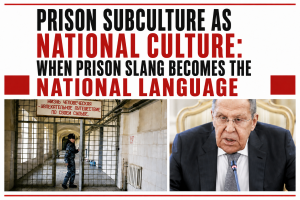
Russia is a carceral-prison state. And not because there are many prisons and many prisoners (and there will be even more prisoners and more prisons) but because the prison subculture has, in fact, eroded the boundaries between the prison subculture and the national culture. It has supplanted national culture, becoming, in fact, the national culture — and this is the essence of the Russian state, which suits the Russian people perfectly.
It is inconceivable without a vertical structure of governance based on informal prison laws formed many centuries ago. And it is precisely this accusation — that if Western countries want to talk ‘according to the concepts’, then they can talk ‘according to the concepts — that is evidence of a litmus test of how much this ‘understanding’ structure, “understanding” essence, and ‘understanding’ orientation reflect the Russian state.
Today, it is not enough to talk about the normalisation of rudeness as a form of communication. More telling is the normalisation of criminal slang in official discourse.
The use of prison subculture terminology, such as ‘by the concepts’, in speeches by high-ranking Foreign Ministry officials is not a coincidence or a stylistic device. It is evidence of the deep integration of criminal and prison mentality into the state apparatus, when the language of the criminal world becomes the language of the state.
Particularly cynical is the attempt to extrapolate this criminal slang to Western countries. Accusing Western states of wanting to ‘talk according to the concepts’ is a classic example of projecting one’s own practices onto others. Russia is trying to present its own degradation as a universal norm, claiming that the use of prison terminology and methods is characteristic of all countries. This is not just a rhetorical device, but an attempt to legitimise its own criminal nature through its imagined universalisation.
This rhetoric reflects a broader strategy of spreading Russian methods of diplomacy to the international arena. Moscow not only applies criminal ‘concepts’ in its own relations, but also actively tries to impose this logic on other countries. The goal is to lower the standards of international interaction to the level of power and criminal structures, where instead of the law, the ‘law of the strong’ and informal agreements ‘according to concepts’ prevail.
Finally, the most alarming is the process of normalising the criminality of the Russian state, both internally and externally. When prison subculture becomes the basis of state identity, when the methods of the criminal world determine diplomatic strategy, and the language of prison is heard from the rostrum of the Ministry of Foreign Affairs, this is no longer just a metaphor, but a statement of fact. Russia does not simply have a prison system; it is itself a prison system that is trying to turn the whole world into its prison by imposing its ‘concepts’ and its criminal logic on it.