The Carceral Nature of Russian Statehood: a Critical Analysis of Contemporary Russian Society

The main and most common, yet most dangerous mistake made by most Western researchers, analysts, and politicians in understanding Russian society and the Russian state is the artificial opposition of the people to the authorities, the people to the regime, and the people to the political elites. According to this approach, it is emphasised that the people are dependent on the authorities, they are enslaved, they are dependent, they have neither the strength nor the desire to escape this dependence in order to build a qualitatively new democratic society. Such an interpretation of Russian socio-political reality, despite its prevalence in Western academic and political discourse, contains a fundamental methodological flaw that makes it impossible to adequately understand the nature of the historically, politically, and economically conditioned Russian state and the specifics of its relationship with its own population.
This is precisely where the critical error lies, because such a simplistic approach completely excludes two fundamentally important factors, without which any analysis of the Russian political system remains superficial and methodologically flawed.
First, it ignores the centuries-long history of the Russian Empire, whatever it was called at different stages of its existence: the Moscow Tsardom, the Russian Empire, the Soviet Union, the Russian Federation. This historical continuity of the imperial tradition is not accidental or situational, but is an organic part of Russian state identity, which has been formed over centuries and institutionalised in specific forms of social organisation.
Secondly, and this is perhaps most important for understanding contemporary realities, this approach does not take into account the Russian people’s own desire to remain within this system of Russian power. Ignoring this factor leads to the Russian population being viewed exclusively as a passive object of manipulation by the authorities, rather than as an active subject that consciously or unconsciously supports and reproduces the existing system of relations.
The Russian state and Russian society are a unique phenomenon, which has no analogues in history and, most likely, will not have any in the near future. This uniqueness is explained by the fact that the Russian state was formed as a prison state. Moreover, not even as a police state in the classical sense of the term, but precisely as a prison state, where several interrelated and mutually reinforcing processes are inextricably intertwined in one direction. The colonial policy of the Russian Empire, aimed at the constant expansion of territories and the subjugation of new peoples, was combined with an imperialist orientation that justified this expansion as a civilizing mission.
The need to assimilate vast territories east of the Urals and to the south required the mobilisation of significant human and material resources, but the lack of sufficient resources for such assimilation in the traditional colonial sense forced the Russian state to resort to a specific mechanism of colonisation. This mechanism consisted of involving its own people, who were stigmatized as ‘criminals’, as well as the populations of conquered territories such as Ukraine, Belarus, Estonia, Latvia, Lithuania, and many other countries, whose representatives were sent en masse to the east for forced colonisation.
It was thanks to this unique combination of colonial expansion, imperial ideology, and prison practices that the Russian state acquired the status of a prison, not because of the number of prisons or the number of prisoners, although these indicators were traditionally extremely high, but because of the fundamental blurring of the boundaries between prison and society, between national culture and prison culture.
This blurring process was not instantaneous nor artificially imposed; it took place gradually, over centuries, as prison culture first began to dominate national culture, then supplant it, and eventually became the national culture itself. A kind of inversion took place when marginal cultural practices, characteristic of the criminal environment and places of deprivation of liberty, penetrated the national cultural space and began to determine the norms of behavior, value systems, and language practices of broad segments of the population.
All these things must be taken into account when analyzing Russian statehood and society, but it is precisely this penal, prison factor that is systematically overlooked by Western researchers due to methodological limitations. Western analysts, who essentially equate the Russian population with themselves, projecting their own cultural, historical, and political experiences onto it, do not take into account the fundamental differences in the trajectories of historical development. Russia did not have a French Revolution with its slogans of liberty, equality, and fraternity, nor did it have an American Revolution with its cult of individual rights and restrictions on state power, nor did it have other revolutions of the same nature and direction that characterised the formation of all European nations. The absence of bourgeois-democratic revolutions meant the absence of the formation of civil society in the Western understanding of the term, the absence of a tradition of limiting state power by law, and the absence of a culture of political participation and civic responsibility.
This absence, this historical vacuum, was compounded by the utterly humiliating position of private property, which never acquired in Russia the sacred status it had in Western societies. The absence of a guaranteed right to private property meant the absence of an economic basis for the formation of an independent civil society and a political class that could resist the arbitrariness of state power. This, in turn, was compounded by the penal-prison nature of both Russian domestic and foreign policy, where methods of governance typical of penitentiary institutions were systematically applied to the governance of society as a whole. The combination of these factors created the unique prison empire that modern Russia continues to be, despite formal changes in the political regime and economic system.
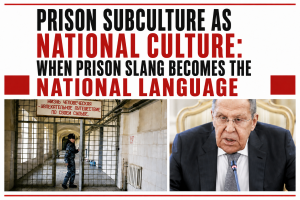
In this context, the phenomenon of the “Russian world” serves as an ideological justification for the spread of Russian narratives and expansionist policies, giving them a pseudo-cultural and pseudo-civilisational dimension. A striking example of the penetration of prison subculture into the highest levels of Russian state power is the scandalous speech by Russian Foreign Minister Sergey Lavrov, who publicly used criminal jargon and the conceptual apparatus of prison subculture to characterize international relations. This case demonstrates a systemic phenomenon in which representatives of the highest levels of power consider it entirely acceptable and natural to publicly use vocabulary and conceptual schemes borrowed from the criminal environment.
Therefore, the real danger to large social groups of the modern Russian people (and such a danger exists) does not lie in the fact that they are supposedly enslaved, subjugated, or dependent on the elites, as is usually interpreted in Western discourse. Such an interpretation is methodologically flawed because it is based on the false assumption of the passivity of the Russian population and its fundamental similarity to the populations of Western democracies. In reality, the Russian people are not passive victims of the regime, but active carriers, conscious adherents, and effective agents of this carceral Russian imperial subculture. This is an unprecedented phenomenon in world history, which is difficult for European researchers to understand precisely because of the absence of similar historical experience in their own cultural tradition.
Understanding this fundamental difference is critical to the formation of an adequate policy toward Russia and to a realistic assessment of the prospects for democratic transformation in that country. As long as Western analysts and politicians proceed from the false assumption of a conflict between the people and the authorities in Russia, their policies will be based on false premises and doomed to ineffectiveness.
It must be recognised that Russian society as a whole is not a captive democratic society awaiting liberation from a tyrannical regime but rather an organic part of a prison empire, a bearer of its values, and an active participant in its reproduction. Only such a realistic assessment can form the basis for effective policies that take into account the real, rather than imagined, characteristics of Russian society and the state.