The Siege Society: Russia’s Carceral State and the Reproduction of Imperial War

An analysis of contemporary Russia through the prism of the concept of a carceral state allows us to rethink the nature of its outwardly aggressive behaviour. A carceral state is not just a set of repressive institutions directed inward toward society; it is a special form of socio-political organisation where discipline, coercion, and fear serve as fundamental mechanisms for reproducing the legitimacy of power. Applied to Russia, this concept reveals the regime’s deep structural dependence on a constant ‘enemy’ — real or constructed, internal or external.
For the Russian Empire, regardless of its institutional form — tsarist, Soviet or federal — war was not an anomaly but a systemic factor of internal stability. The doctrine of a ‘siege society,’ characteristic of a carceral state, requires permanent mobilisation, which makes it impossible for society to reflect on its own situation. Putin’s regime has taken this mechanism to its extreme: from the Chechen campaigns of 1999, through the armed intervention in Georgia (2008), the annexation of Crimea (2014) to the full-scale invasion of Ukraine (2022) — each escalation marked not a deviation from the ‘norm’ but a logical reproduction of institutional logic.
The conceptual essence of Putin’s model of governance is that war performs at least three interrelated functions of a prison state. First, it ensures the delegitimisation of any opposition by stigmatising criticism as ‘treason’ and ‘working for the enemy’ — a classic prison mechanism for neutralising dissent. Second, it redirects public attention away from structural failures in the economy: for more than a decade, real incomes in Russia have been stagnating or declining, while Kremlin rhetoric obsessively appeals to ‘external threats.’ Third, constant military mobilisation generates new corporate interests — the military-industrial complex, the military-administrative nomenclature, ‘volunteer’ structures — which are an integral part of the prison economy, which exists not in spite of repression, but because of it.
A hypothetical cessation of hostilities would inevitably confront the regime with systemic challenges: demobilised militants accustomed to social status and higher payments; a degraded ‘civilian’ economy without market adaptation; and enormous public expectations regarding the ‘fruits of victory.’ It is this structural impossibility of ‘peace without collapse’ that explains why the military imperative is not Putin’s tactical choice, but a systemic attribute of a prison state that is incapable of reproducing itself in conditions of relative normality.
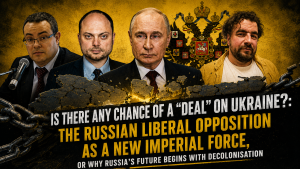
However, a methodological caveat is fundamentally important: any analysis that reduces Russia to ‘the dictator and his victims’ reproduces an intellectual error that allows one to avoid the painful but necessary question of social subjectivity. The Russian regime is the flesh and blood of the Russian people — and this is not a rhetorical figure, but an analytical thesis. Putin’s regime does not exist in a vacuum: it is rooted in a 500-year-old tradition of imperial thinking that organically combines self-identification through colonial expansion, ‘land gathering’ and the depersonalisation of conquered peoples.
The concept of a carceral state takes on a special analytical dimension in this context: while traditional criminology views prison practices as external coercion against the subject, in the case of Russia we are dealing with the phenomenon of internalised prison thinking. For centuries, prison and camp culture (from Siberian penal servitude to the Gulag) has not only determined state practices, but also permeated public consciousness, forming specific codes of masculinity, submission, violence and loyalty.
Granting Russian society the status of a collective ‘victim’ — whether of Kremlin propaganda or Putin’s kleptocracy — is not only analytically flawed but also practically harmful. It relieves society of moral and legal responsibility for colonial aggression and makes it impossible to comprehend the scale of the necessary denazification transformation. The carceral state reproduces itself through the consensus of its subjects no less than through coercion.
The correct analytical framework requires recognition that the Russian military imperative is neither a purely personal pathology nor an exclusively institutional dysfunction — it is a systemic product of a five-hundred-year-old tradition, in the reproduction of which a significant part of Russian society actively participates.
Accordingly, any post-conflict settlement that ignores this deep social dynamic is doomed to reproduce the conditions for a new cycle of aggression.